SEO Compliance Checklist for Regulated Gambling Sites


For regulated gambling operators, SEO compliance is not simply about visibility in search results. It is about aligning search engine optimization with strict regulatory requirements, responsible gambling standards, and Google’s guidelines.
In highly scrutinized markets, gambling websites must satisfy both legal frameworks and search engines simultaneously. Failure to maintain SEO compliance can result in lost search engine rankings, reduced organic traffic, penalties under advertising laws, or even de-indexation from Google search results.
SEO compliance refers to ensuring that a gambling website aligns with Google Search Essentials, webmaster guidelines, and jurisdiction-specific gambling regulations. Because gambling falls under sensitive and financial-impact categories, search engines apply stricter ranking factors related to user trust, transparency, and content quality.
For regulated gambling sites, being SEO compliant is both a marketing necessity and a compliance obligation.
What Does SEO Mean in the Gambling Industry?
Search engine optimization in regulated gambling involves optimizing sportsbooks, casinos, poker and betting platforms so that search engines can index and rank their websites’ content appropriately within search engine results pages.
When users search for betting platforms, online casino bonuses, odds comparisons, or free spins in Google Search, search engines evaluate keyword relevance, content quality, authority signals from reputable websites, compliance with Google’s guidelines, and technical performance factors such as page speed and mobile-friendly structure.
Unlike other industries, gambling operators must balance search engine rankings with advertising restrictions, geo-targeting controls, and age-verification requirements. SEO efforts in this sector must therefore be structured, documented, and continuously audited to ensure the site remains SEO compliant while protecting licensing status.
What Does SEO Compliant Mean for Gambling Operators?
To be SEO compliant in regulated gambling means adhering to Google’s guidelines, webmaster guidelines, and Google Search Essentials while also respecting regulatory advertising rules.
An SEO compliant gambling platform demonstrates that its website’s performance supports efficient crawling, that keyword research reflects legitimate keyword relevance within licensed jurisdictions, and that meta tags and meta descriptions accurately describe the page title without misleading promotional claims.
Internal linking must connect multiple pages logically, particularly linking promotional content to responsible gambling disclosures. Website speed and page speed must meet performance expectations across mobile devices. Google Search Console should show no unresolved crawl errors affecting compliance pages such as licensing, terms and conditions, or bonus policies.
In regulated gambling, SEO compliance also requires that bonus language, wagering requirements, and promotional offers are transparent. This alignment helps search engines understand the structure of the site and reinforces credibility in Google search results.
When these elements are consistently maintained, the website remains SEO compliant and supports sustainable search engine rankings.
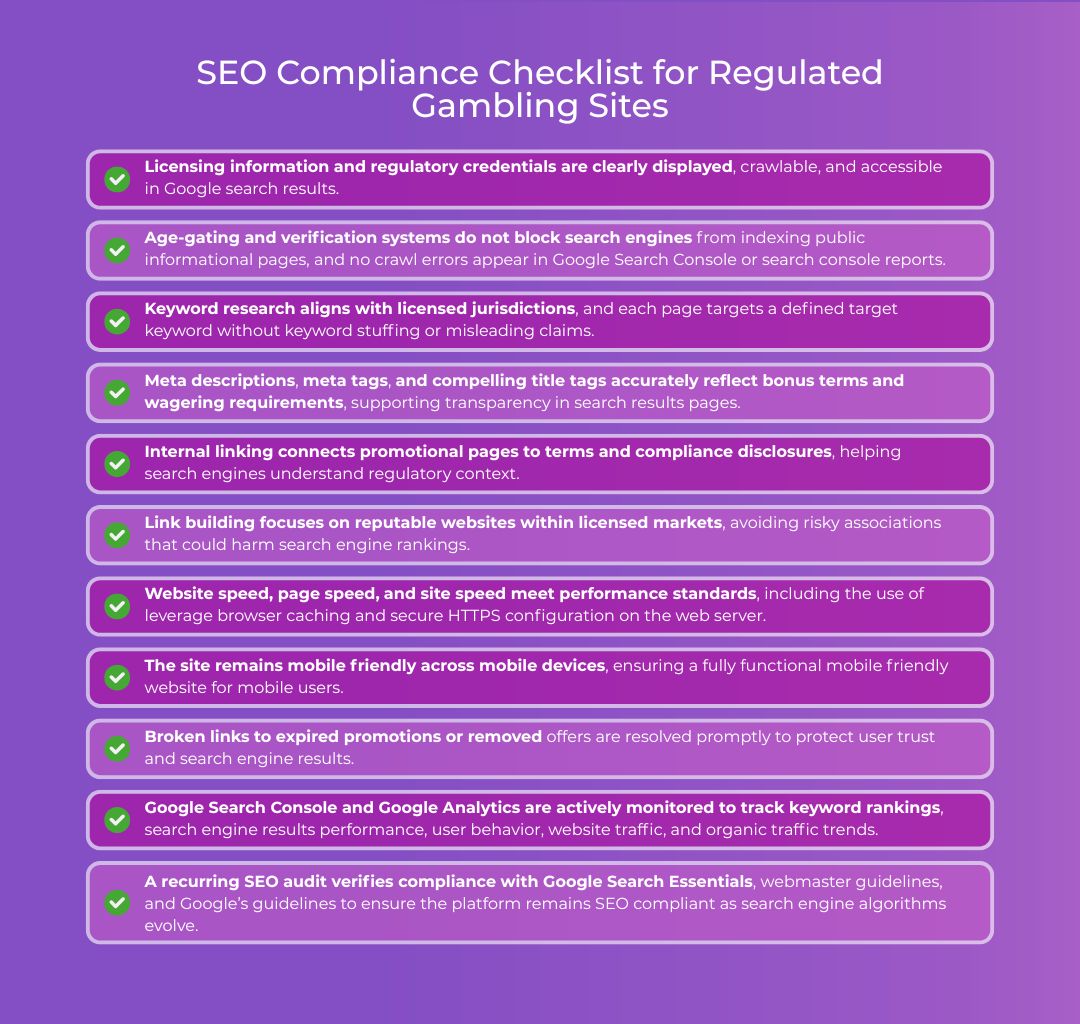
SEO Compliance Checklist for Regulated Gambling Sites
For regulated operators, SEO compliance must be measurable and operational. The following checklist summarizes the core requirements for remaining SEO-compliant while protecting licensing integrity and search engine rankings.
What Are SEO Standards in Regulated Gambling?
SEO standards are the operational principles that govern compliant SEO practices. In gambling, these standards are influenced by Google Search Essentials and jurisdiction-specific gambling advertising laws.
The table below illustrates how core SEO standards apply to regulated gambling websites.
| SEO Standard | Regulatory Significance | Impact on Search Engine Rankings |
| High-quality content | Prevents misleading bonus or payout claims | Strengthens organic traffic and keyword rankings |
| Meta descriptions and meta tags | Must avoid deceptive language | Improves click-through from the search results page |
| Internal linking | Connects promotional pages to compliance pages | Enhances crawlability and transparency |
| Link building from reputable websites | Avoids association with unlicensed operators | Improves authority in search engine results |
| Mobile-friendly website | Ensures accessibility for mobile users | Influences ranking factors |
| Page speed and site speed | Reduces friction and abandonment | Supports stable search engine rankings |
| Structured keyword research | Aligns with licensed markets only | Improves keyword rankings and visibility |
These SEO rules are designed to protect user trust, preserve the integrity of search engine results pages, and ensure gambling operators promote services responsibly.
The Four Pillars of SEO for Gambling Sites
SEO compliance in regulated gambling can be understood through four pillars: technical SEO, on-page SEO, off-page SEO, and content governance.
Technical SEO: Infrastructure and Regulatory Transparency
Technical SEO ensures that search engines can crawl and index gambling websites efficiently. Crawl errors identified in Google Search Console must be addressed immediately, particularly if they affect licensing disclosures or responsible gambling information.
A properly configured web server, secure HTTPS protocol, optimized site speed, and effective leverage of browser caching improve website speed and the overall website’s performance. Because gambling platforms often operate across multiple pages for different jurisdictions, technical precision is critical.
A mobile-friendly website is essential as many betting users rely on mobile devices. Failure to maintain mobile-friendly functionality weakens search engine results and may negatively impact organic traffic growth.
On-Page SEO: Controlled Keyword Strategy and Compliance Messaging
On-page SEO compliance ensures that each page aligns with a defined target keyword while respecting advertising restrictions. Keyword research must evaluate keyword volume, keyword rankings, and keyword relevance within licensed territories.
Keyword usage must remain natural and avoid keyword stuffing. Relevant keywords should appear within headings, body text, meta descriptions, and the page title without exaggeration.
Compelling title tags and a good meta description influence click-through behavior on the search results page. In gambling, meta descriptions must accurately represent wagering requirements and bonus conditions.
Internal linking strengthens authority across multiple pages, especially when linking bonus offers to terms and responsible gambling resources. This structure helps search engines understand compliance context and reinforces website’s SEO integrity.
Off-Page SEO: Risk-Aware Link Building
Link building remains one of the strongest ranking factors within search engine algorithms. However, gambling operators face elevated scrutiny.
Backlinks from black-market gambling affiliates, spam networks, or irrelevant other websites can damage search engine rankings and trigger manual actions in Google Search Console.
Compliant SEO requires link-building partnerships with reputable websites operating within licensed jurisdictions. Ethical outreach, transparent affiliate disclosures, and ongoing backlink audits are essential to maintaining search engine results stability.
Content Governance: Protecting User Trust
High-quality content remains central to SEO compliance. Gambling content must align with user intent while avoiding unrealistic promises.
When users search for betting offers, search engines prioritize websites’ content that is transparent, structured, and legally compliant. Duplicate content, exaggerated claims, or missing disclosures weaken authority and reduce organic traffic.
An effective SEO strategy integrates keyword research, keyword rankings monitoring, and compliance oversight. Content updates should reflect regulatory changes and the latest evolving SEO trends.
Monitoring Compliance with Google Search Console and Google Analytics
Google Search Console and search console tools provide critical visibility into search engine results performance. Operators can monitor crawl errors, keyword rankings, and impressions in Google search results.
Google Analytics complements this by analyzing website traffic patterns, user behavior, and organic traffic performance across jurisdictions.
Together, Google Search Console and Google Analytics provide valuable insights into ranking factors and a website’s SEO effectiveness. Regular monitoring ensures that the site remains SEO compliant even as search engine algorithms evolve.
Conducting an SEO Audit for Regulated Gambling Sites
An effective SEO audit evaluates a website’s performance, keyword rankings, and regulatory alignment.
The following table outlines core audit components for gambling operators.
| Audit Area | Tool | Regulatory Purpose |
| Crawl errors | Google Search Console | Protect licensing and disclosure pages |
| Page speed | Performance tools | Improve website speed and retention |
| Meta descriptions review | On-page analysis | Prevent misleading bonus language |
| Internal linking structure | SEO tools | Strengthen compliance transparency |
| Backlink profile | Link analysis tools | Avoid non-compliant affiliates |
| Keyword rankings | Search console | Monitor target keyword stability |
Regular SEO audit implementation ensures organic traffic stability and reduces regulatory risk.
SEO Compliance in the Context of AI and Evolving Search Engines
Modern search engines increasingly use AI to interpret gambling content. As Google Search integrates AI-generated summaries and enhanced search results pages, structured content and semantic clarity become essential.
Accurate meta tags, transparent terms, and clear responsible gambling messaging help search engines understand contextual relationships. This strengthens eligibility for rich search engine results and protects search engine rankings.
Other search engines apply similar standards, reinforcing the need for consistent, compliant SEO practices across platforms.
SEO Compliance and Long-Term Growth in Gambling
SEO compliance supports sustainable organic traffic and stable search engine rankings in regulated markets. By aligning SEO efforts with Google’s guidelines and jurisdictional regulations, gambling operators protect both visibility and licensing integrity.
An SEO compliant website builds authority gradually through ethical link building, structured keyword research, consistent SEO audit processes, and ongoing monitoring in Google Analytics and Google Search Console.
Website owners who treat SEO compliance as an ongoing governance discipline rather than a one-time initiative are better positioned to maintain user trust, protect brand reputation, and achieve long-term digital authority within search engine results.
Why SEO Compliance Is Essential
SEO compliance is the structural foundation of search visibility for regulated gambling sites. It ensures alignment with Google’s guidelines, Google Search Essentials, and webmaster guidelines while supporting regulatory transparency.
To remain SEO-compliant, gambling operators must maintain high-quality content, optimize meta descriptions and meta tags responsibly, strengthen internal linking, resolve crawl errors in the Search Console, improve website speed, and ensure keyword research aligns with licensed jurisdictions.
In a sector where regulatory oversight is constant and search engines apply heightened scrutiny, compliant SEO is not optional. It is the essential framework that enables sustainable search engine rankings, consistent organic traffic, and long-term operational legitimacy.
Find iGaming SEO services here.
FAQs
What does SEO compliant mean for regulated gambling sites?

SEO compliant means that a gambling website aligns with Google’s guidelines, Google Search Essentials, and relevant webmaster guidelines while also meeting jurisdiction-specific regulatory requirements. For regulated operators, SEO compliance ensures that search engines can crawl, index, and rank content appropriately without misleading claims, prohibited targeting, or violations of advertising rules. An SEO compliant gambling site balances search engine optimization with legal transparency and responsible gambling standards.
What does SEO mean in the context of online gambling?
SEO, or search engine optimization, refers to optimizing a gambling website so that search engines can understand, index, and display its pages in search engine results pages. In gambling, SEO involves structured keyword research, compliant meta descriptions, internal linking, link building from reputable websites, and technical optimization such as mobile-friendly design and page speed improvements. The goal is to improve search engine rankings while remaining fully compliant with regulatory frameworks.
Why is SEO compliance especially important for gambling operators?
Gambling is classified as a sensitive category by search engines because it involves financial risk. As a result, ranking factors emphasize user trust, transparency, and content quality. Failure to maintain SEO compliance can lead to reduced search engine rankings, manual penalties in Google Search Console, removal from Google search results, or regulatory scrutiny. SEO compliance protects both organic traffic and licensing credibility.
What are the four pillars of SEO for regulated gambling sites?
The four pillars of SEO in regulated gambling are technical SEO, on-page SEO, off-page SEO, and content governance. Technical SEO ensures proper website speed, crawlability, and mobile-friendly performance. On-page SEO focuses on keyword relevance, compliant meta tags, and transparent bonus terms. Off-page SEO centers on ethical link building from reputable websites. Content governance ensures high-quality content, responsible gambling messaging, and alignment with user intent. Together, these pillars support long-term search engine rankings and sustainable organic traffic growth.
How does keyword research work in regulated gambling markets?
Keyword research identifies relevant keywords, keyword volume, and keyword ranking opportunities within licensed jurisdictions. Operators must avoid targeting restricted markets or using misleading promotional phrases. Each page should focus on a defined target keyword while maintaining natural keyword usage and avoiding keyword stuffing. Proper keyword research supports both search engine rankings and regulatory compliance.
How do meta descriptions and title tags affect gambling SEO?
Meta descriptions and compelling title tags influence click-through rates from the search results page. In regulated gambling, a good meta description must accurately represent bonus conditions, wagering requirements, and eligibility criteria. Misleading meta tags may violate Google’s guidelines and regulatory standards, negatively impacting search engine results and user trust.
What role does Google Search Console play in SEO compliance?
Google Search Console helps gambling operators monitor crawl errors, keyword rankings, indexing status, and search engine results performance. It allows website owners to identify compliance issues affecting visibility in Google search. Regular monitoring ensures the site remains seo compliant as search engine algorithms evolve.
How often should regulated gambling sites conduct an SEO audit?
A comprehensive SEO audit should be conducted regularly, particularly when launching new promotions, entering new markets, or updating compliance policies. An SEO audit evaluates a website’s performance, broken links, page speed, internal linking, backlink profile, and alignment with Google Search Essentials. Routine audits help maintain organic traffic stability and protect search engine rankings.
Does mobile optimization affect gambling SEO?
Yes. A mobile-friendly website is essential because many users search and place bets on mobile devices. Search engines prioritize mobile-friendly performance as a ranking factor. Optimizing site speed, page speed, and usability for mobile users directly supports search engine results and organic traffic growth.
Can poor link building harm a gambling site’s rankings?
Yes. Link building from low-quality or unlicensed gambling directories can negatively impact search engine rankings and trigger manual penalties. Compliant SEO requires backlinks from reputable websites within regulated markets. Ethical link building strengthens authority while protecting long-term search engine results visibility.