


Google Ads Gambling Policy: The Ultimate Certification Guide


The most immediate trap is misinterpreting what Google means by “Allowed.” Many assume that if a country appears on the approved list, it is open to any entity holding a recognized gaming license. In reality, the designation often indicates that online gambling is legal only for government-sanctioned entities. This is the state-monopoly mirage: the territory is technically open but effectively closed to private competition. Launching campaigns based solely on the “Allowed” tag without verifying eligibility risks immediate suspension and wasted certification efforts.
The regulatory landscape strictly divides open licensing systems and state-controlled markets. In many European and Asian jurisdictions, “Allowed” status applies exclusively to the national lottery or a state-run agency. Private operators, even with reputable licenses from Malta or Gibraltar, are often deemed gray-market or illegal. Gambling and games country restrictions list over 30 countries requiring specific licenses for Google Ads certification; without a local permit, ads are disapproved regardless of global standing.
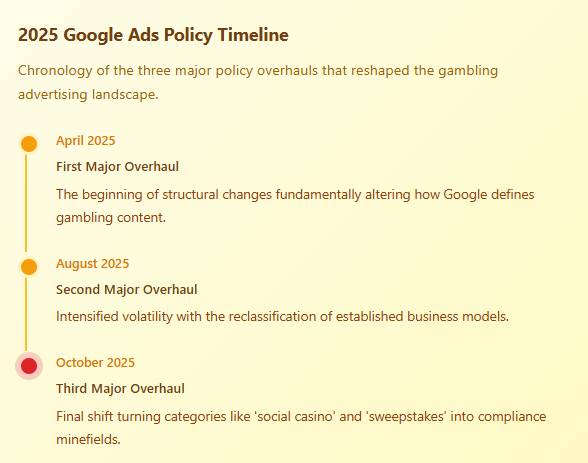
The United States is the most complex example of this fragmented geography, lacking federal allowance. Instead, the market operates as a collection of fifty separate regulatory fiefdoms with unique certification requirements. According to the AGA: Commercial Gaming Revenue Tracker, 38 US states have legal Online Sports Betting, yet each requires a distinct application and state-level licensure. Markets can also freeze unexpectedly; new certification applications for Australia are paused as of August 25, 2025, halting expansion plans for many affiliates and operators.
Decision Framework
3 key decisions to make
Click to expand
Market Entry Eligibility Framework: Navigating Google Ads Gambling Policies
This framework helps advertisers determine if a target country listed as ‘Allowed’ by Google is genuinely open to private competition or restricted to state monopolies. Use it to evaluate market feasibility and licensing requirements before applying for certification.
1. Is the target market an Open Licensing System or a State Monopoly?
Google’s ‘Allowed’ status is often a ‘mirage.’ It includes countries where online gambling is legal only for government entities. Distinguishing between open markets and state monopolies is the first critical step to avoid account suspension.
2. Does your current licensing portfolio meet local certification requirements?
A common trap is assuming a Tier 1 global license (Malta, Gibraltar) or offshore license (Curacao) covers all ‘Allowed’ countries. Google usually requires a country-specific permit.
3. How should you approach Federal/Fragmented Nations (US, Canada, Germany)?
In federal nations, ‘National Allowance’ does not exist. Regulations vary by state or province. For example, the US has 38 separate legal sports betting jurisdictions.
Avoid these mistakes:
- ⚠️ Assuming ‘Allowed’ means open for all private businesses.
- ⚠️ Applying for certification in a State-Monopoly market with a foreign license.
- ⚠️ Using a ‘Global’ license for countries that require local permits (30+ countries).
- ⚠️ Launching a US-wide campaign with a license valid for only one state.
- ⚠️ Ignoring temporary pauses, such as the Australian application halt as of August 2025.
- License Specificity: A ‘Global’ license (e.g., Curacao) is rarely sufficient for Tier 1 ‘Allowed’ countries; local certification is almost always required.
- Vertical Restrictions: A country may be ‘Allowed’ for Sports Betting but completely ‘Restricted’ for Online Casino; never assume a blanket permission.
- Monopoly Indicators: If the policy page lists only government entities or a single authorized provider, private competition is banned.
- State-Level Granularity: In federal nations like the US, Canada, and Germany, regulations often vary wildly across state or provincial lines.
Why Sweepstakes Are No Longer Safe Social Casinos
For years, the ‘Sweepstakes Model’ occupied a lucrative gray area, allowing operators to bypass Real Money Gambling (RMG) licensing by filing as ‘Social Casinos.’ Users purchased ‘Gold Coins’ for entertainment and received ‘Sweeps Coins’ as a redeemable bonus. But the October 2025 policy update dismantled this framework. Google now categorizes any app or site offering a redemption mechanism, regardless of the ‘no purchase necessary’ defense, as Real Money Gambling, ending the era of running sweepstakes ads with a simple social certification.
Ad Classification: Pure Social vs. Sweepstakes (Post-2025)
Pure Social Casino (Closed Loop)
Pros
- + Eligible for ‘Social Casino’ certification
- + Global reach with fewer geo-restrictions
- + Lower CPCs due to broader inventory access
Cons
- – Zero monetization via redemption (IAP only)
- – Lower LTV per user compared to RMG
- – Retention relies solely on gameplay mechanics
Sweepstakes Model (Redeemable)
Pros
- + High user LTV and engagement
- + Compelling value proposition for creatives
- + Higher conversion rates than pure social
Cons
- – Must hold ‘Online Gambling’ certification
- – Requires specific state-level gambling licenses
- – Severely restricted inventory availability
Verdict: The middle ground has vanished. You must either strip redemption features to remain ‘Social’ or acquire state gambling licenses to remain ‘Sweepstakes’.
This shift centers on redefining ‘payout value.’ Previously, Social Casino certification only prohibited direct real-money wagering, but the 2025 update expands this to ‘indirect value transfer.’ If a platform uses a dual-currency system where *any* tier exchanges for gift cards, crypto, or cash, Google now treats it as a gambling service. Consequently, ‘Social Casino’ is reserved for ‘play-for-fun’ models with closed-loop economies and zero exit liquidity.
This reclassification creates an immediate crisis for advertisers relying on the sweepstakes loophole. To advertise, operators must forfeit Social Casino status and apply for ‘Online Gambling’ certification. The catch is a licensing mismatch: while sweepstakes models operate legally under federal law, they are rarely regulated by state gambling commissions like the NJ DGE or Michigan GCB. Because Google requires a state-issued license, operators are stranded; they are too ‘risky’ for Social Casino ads, yet lacking the licensure needed for Real Money Gambling.
- Zero Payout Mandate: To qualify as a Social Casino in 2025, your platform must have absolutely no mechanism for converting in-game success into real-world value.
- Dual-Currency Red Flag: The presence of a secondary ‘redeemable’ currency (Sweeps Coins) now automatically triggers the Real Money Gambling policy classification.
- Certification Void: Existing Social Casino certificates for sweepstakes apps are being retroactively revoked; advertisers must re-apply under the Online Gambling framework or cease advertising.
- Licensing Gap: Transitioning to the Real Money category is often impossible for sweepstakes operators because they generally lack the state-specific gambling licenses Google demands.
Technical Triggers That Cause Immediate Ad Disapprovals
While classification in the ‘Social’ versus ‘Real Money’ matrix is strategic, technical compliance is binary. The most pervasive error in 2025 is the ‘Destination Mismatch’ flag, often triggered by license documentation hosting rather than the ad itself. Google’s crawler traces every link on your landing page. If your license is hosted on a third-party service like Dropbox, Google Drive, or a generic CDN (rather than your root domain), the crawler detects a deviation from the advertised URL. This triggers immediate disapproval, flagging the external link as potential cloaking or a misleading destination.
Beyond hosting issues, affiliate links are a primary trigger for ‘Circumventing Systems’ bans. Google explicitly prohibits ‘bridge pages’ designed solely to send users elsewhere. If your landing page contains direct tracking links or buttons redirecting immediately to third parties, algorithms classify it as lacking original content, which is identical to malicious arbitrage. To remain compliant, the page must be the final destination where value is delivered; affiliates must offer substantial reviews or comparison tools before any outgoing click.
Deep Checklist
27 items across 5 categories
Click to expand
Landing Page Technical Compliance Audit: Gambling Policy
This checklist guides the technical audit of gambling landing pages to prevent ‘Crawler Contagion’ and immediate disapproval. It focuses on hosting architecture, URL consistency, bridge page indicators, and crawler accessibility to ensure alignment with Google Ads Gambling Policy 2025.
URL Architecture & Domain Consistency (5 items)
Ensures the foundational link structure prevents ‘Destination Mismatch’ flags.
Confirm that the Display URL, Final URL, and all critical asset URLs share the exact same root domain.
💡 Discrepancies here are the #1 cause of ‘Destination Mismatch’.Ensure the landing page resolves immediately to the final version without intermediate redirects.
💡 Google’s crawler may time out or flag complex redirect chains as cloaking.If using a subdomain (e.g., play.brand.com), ensure the license file is accessible via that same subdomain hierarchy if required by local regulation.
Ensure the license PDF link is a static path (e.g., /license.pdf) rather than a dynamic string (e.g., /view.php?id=123).
💡 Static paths are easier for the crawler to verify as a document.If assets are on a subdomain, verify CORS headers allow the main crawler to inspect them without errors.
License Asset Hosting & Visibility (6 items)
Prevents disapproval caused by third-party hosting and obscured license documentation.
Move the gambling license document from any cloud storage (Dropbox, G-Drive) to the web server’s root directory.
💡 Third-party hosting triggers immediate ‘Destination Mismatch’.Remove any iFrames used to display the license. Link directly to the file or display text natively in HTML.
💡 iFrames block the crawler from verifying the document content.Check that the license URL returns a strictly 200 OK status code (not 403, 404, or 301).
Ensure the license link is a standard HTML <a href> tag, not a button triggering a JS download event.
💡 Crawlers do not ‘click’ JS buttons effectively.Ensure the license PDF is text-readable (OCR’d) and not just an image scan, allowing the crawler to parse the license number.
Ensure the folder containing the license (e.g., /assets/ or /docs/) is not disallowed in robots.txt.
💡 If the crawler is blocked from the folder, it cannot verify the license exists.
Bridge Page & Affiliate Compliance (6 items)
Ensures the user journey offers value and avoids ‘Circumventing Systems’ flags.
Identify all outbound tracking links. Ensure they are not the primary element of the page.
💡 Direct redirects from landing pages are flagged as malicious arbitrage.Scan header and body code for meta-refresh tags or JS window.location scripts that redirect users automatically.
💡 Immediate redirects are a primary trigger for bans.Ensure the page contains unique reviews, comparison tables, or odds analysis that provides value *before* the user clicks out.
💡 The crawler must categorize the page as a destination, not a bridge.Add ‘rel=sponsored’ or ‘rel=nofollow’ attributes to all outbound commercial links to comply with Google’s link spam policies.
Disable interstitial pop-ups that load immediately, as these can be interpreted as cloaking or obstructing the user path.
Ensure distinct separation between editorial content and affiliate call-to-actions.
Crawler Accessibility & Technical Hygiene (6 items)
Optimizes the technical environment so the ‘impartial auditor’ (Googlebot) sees the compliant page correctly.
Verify the page passes the Mobile-Friendly test, as Google uses mobile-first indexing for policy checks.
💡 A broken mobile layout can obscure compliance text from the bot.Ensure Google’s US-based crawlers (and regional bots) are not blocked by firewall geofencing rules.
💡 If the crawler gets a 403 Forbidden due to geography, the ad is disapproved.Ensure main content (especially license info) loads within the first 2-3 seconds to prevent crawler timeouts.
Scan for scripts that serve different content to User-Agents identifying as ‘Googlebot’.
💡 This is a permanent suspension trigger.Fix any 404 errors on the landing page, as these suggest a low-quality or unfinished site to the algorithm.
Ensure the SSL certificate is valid, not expired, and covers the exact domain variation used.
💡 Security warnings block crawlers effectively.
Pre-Launch Validation (4 items)
Final verification steps before enabling the campaign.
Use the ‘Test Live URL’ feature in Google Search Console to see exactly what the Googlebot renders.
💡 Verify the license text is visible in the rendered code.Navigate the page as a user, clicking the license link to ensure it opens in a new tab without download prompts.
Review the Google Ads Policy Manager for any historical disapprovals on the domain before submitting new ads.
Take timestamped screenshots of the landing page and license location in case manual appeal is required.
💡 Useful for regulatory bodies and manual Google reviews.
Source: LeoVegas penalised for social responsibility and anti-money laundering failures
Penalties for failing technical standards are not merely administrative inconveniences; they mirror the financial severity of regulatory enforcement. Google’s automated systems defend against systemic failures that lead to massive fines, such as the record £19.2m the William Hill Group paid for social responsibility and anti-money laundering lapses. Google’s policies prevent the digital environments where these breaches occur. Consequently, technical setups that obscure user paths or hide license data are treated with the same severity as regulatory breaches, often resulting in permanent account suspensions rather than simple ad disapprovals.
- Third-Party Hosting: Linking to license PDFs on external domains (e.g., Dropbox) triggers ‘Destination Mismatch’.
- Affiliate Redirects: Direct outbound tracking links on landing pages are flagged as ‘Circumventing Systems’.
- iFrame Obfuscation: Embedding licenses in iFrames often blocks the crawler from verifying the document, leading to verification failure.
- Mismatched Root Domains: The display URL, final URL, and license asset URL must all share the same domain root.
Critical Documents Needed to Pass Verification
The Google Ads gambling certification form is unforgiving, acting less like a portal and more like a timed exam. With no ‘save draft’ feature, sessions time out if you pause to verify details. Treat the application as a ‘pre-flight’ sequence: gather, rename, and validate every asset before clicking the link. Starting unprepared risks restarts and data errors that can flag your account for manual review.
You need your specific Google Ads Customer ID (XXX-XXX-XXXX). Do not submit the Manager Account (MCC) ID; use the sub-account ID where campaigns run, as Google verifies the license against the entity billed there. You also require a high-resolution PDF of your government-issued gambling license. Screenshots are frequently rejected. The document must clearly show the license number, expiration date, and legal entity name matching your Google Ads payment profile exactly.
Certification Pre-Flight Sequence
Gather these critical assets before starting the timed Google Ads application.
Customer ID
Locate specific sub-account ID (XXX-XXX-XXXX), avoiding the MCC ID.
High-Res License
Prepare PDF showing expiration and entity name matching billing.
Jurisdiction Check
Plan separate forms for each targeted country or state.
Age-Gating Audit
Verify landing pages visibly display 18+ or 21+ icons.
Responsible Gambling URL
Direct link to self-exclusion tools and local aid organizations.
Certification is strictly jurisdictional, not global. If you launch in the UK, France, and New Jersey, you cannot submit a blanket application. You must file a separate form for each country or state, attaching the specific license for that geo. Bundling jurisdictions or using out-of-region licenses (like a Malta license for UK ads) results in immediate rejection. Name PDFs by country code to prevent uploading the wrong legal documents during submission.
Beyond administrative documents, your landing pages require a pre-submission compliance audit. The Gambling and games policy strictly enforces an age limit of 18+ (or higher locally). This is not just a campaign targeting setting; your landing page must explicitly display the restriction. Ensure an ’18+’ or ’21+’ icon is clearly visible on the destination URL. If reviewers cannot instantly verify age-gating, certification will be denied regardless of your valid license.
Certification Submission Readiness Checklist
- ✓Verify Google Ads Account Details
- ✓Locate 10-digit Customer ID
- ✓Ensure Payment Profile name matches License name
- ✓Confirm Administrative Access to the account
- ✓Prepare Legal Documentation
- ✓Scan original license to PDF
- ✓Rename file: [Country]_[LicenseType]_[Year].pdf
- ✓Verify license is current and not expired
- ✓Audit Landing Page Compliance
- ✓Confirm 18+ (or 21+) symbol is visible above the fold
- ✓Test the Responsible Gambling footer link
- ✓Ensure HTTPS protocol is active
- ✓Organize Jurisdictional Data
- ✓List all target countries for this batch
- ✓Match specific licenses to each country application
Finally, have your Responsible Gambling URL ready. Google requires a direct link to a page outlining tools like deposit limits, self-exclusion periods, and local aid organizations rather than a generic homepage. With your Customer ID, localized license PDF, separate country lists, and validated URLs prepared, you transform a complex submission into a smooth, five-minute task.
- Google Ads Customer ID (Standard 10-digit format, not MCC ID)
- High-resolution PDF of the valid license for the specific target country
- Direct URL to a dedicated Responsible Gambling info page
- Proof of domain ownership if the URL differs from the license holder name
Resolving Account Suspensions and Analyzing Rejections
Seeing the dreaded red Google Ads suspension banner triggers immediate panic. While the instinct to create a fresh account to keep traffic flowing is strong, it is the most destructive action you can take. Google’s digital fingerprinting links payment profiles, IP addresses, creative assets, and landing page code; creating a new account during a suspension immediately flags you for ‘Circumventing Systems.’ This escalates a fixable technical disapproval into a permanent ban barring your domain and business identity indefinitely. Prioritize containment: do not open new accounts or change your domain URL.
With the perimeter secured, analyze the specific rejection code. In the gambling vertical, the most common suspension trigger is ‘Malicious Software.’ For 90% of legitimate operators, this is a false positive. Google’s crawlers are hypersensitive to complex iGaming scripts, such as geo-location tools, payment gateways, and fraud detection, and default to malware classifications if code is obfuscated or redirects are uninterpretable. Instead of scanning for viruses, audit third-party integrations and ‘minified’ JavaScript files that appear suspicious to automated bots.
Prompt Suite
3-step workflow with AI prompts
Click to expand
Google Ads Suspension Recovery Workflow
A 3-step forensic workflow to handle Google Ads account suspensions. Starting with risk assessment, moving to a technical audit of gambling-specific scripts, and concluding with a data-backed appeal letter.
Before you start:
- Access to Google Ads Policy Manager
- Google Search Console access for the suspended domain
- List of installed third-party scripts (Geo-IP, Payment Gateways, Trackers)
Step 1: Suspension Diagnosis & Containment
You are a Senior Google Ads Policy Specialist specialized in the gambling vertical.

Context:
I have received a notification from Google Ads regarding my account status. I need to determine if this is a fixable ad disapproval or a critical account suspension before taking action. Panic-induced actions like creating new accounts often lead to permanent bans.

Your Task:
1. Analyze the provided notification text.
2. Classify the issue: Ad Disapproval (Granular/Creative-level) vs. Account Suspension (Critical/Account-level).
3. Identify the specific Policy Flag (e.g., Malicious Software, Circumventing Systems, Restricted Gambling).
4. Provide an 'Immediate Containment Plan' listing actions I must strictly AVOID to prevent digital fingerprinting from linking a new account to this suspension.

Input Information:
Notification Text: [PASTE GOOGLE ADS NOTIFICATION HERE]

Output Format:
- Severity Level: [High/Medium/Low]
- Policy Category: [Name]
- Diagnosis: [Explanation of what Google's bot likely found]
- Containment Protocol: [Bulleted list of strict 'Do Nots' regarding new accounts/domains]
- Next Steps: Instructions for the technical audit phase.
Step 2: Technical False-Positive Audit
You are a Full-Stack Web Security Engineer with expertise in iGaming integrations.

Context:
We suspect a false-positive policy flag (likely 'Malicious Software' or 'Unwanted Software'). Gambling sites often trigger this due to complex Geo-IP, fraud detection scripts, and third-party payment gateways which bots interpret as obfuscated code or forced redirects.

Your Task:
Create a forensic audit checklist to identify the technical trigger. Focus on 'minified' JavaScript, third-party integrations, and redirect chains.

Input Information:
- Suspected Policy Flag: [OUTPUT FROM STEP 1]
- My Tech Stack: [LIST SCRIPTS: E.G., GEOCOMPLY, HOTJAR, STRIPE, AFFILIATE TRACKERS]

Output Format:
Structure as a 'Forensic Audit Plan':
1. Script Audit: Specific folders/files to scan (focus on minified JS).
2. Redirect Review: How to check affiliate links/ad servers for blacklisted domains.
3. SSL/Security Check: Verifying certificates and mobile app download flows.
4. Isolation Strategy: Which non-essential scripts (heatmaps, pixels) to disable first to test the flag.

Quality Criteria:
Explain *why* specific gambling scripts (like Geo-IP) trigger false positives.
Step 3: Forensic Appeal Drafting
You are a Google Ads Appeal Strategy Specialist.

Context:
We are appealing a suspension. Vague assurances fail; we must provide technical evidence showing the flagged issue was a misunderstanding of legitimate iGaming technology. We are shifting the narrative from 'Policy Violation' to 'Technical Misunderstanding'.

Your Task:
Draft a formal appeal letter to the Google Policy Manager. Explain the technical root cause found during our audit and prove it is for regulatory compliance, not malware.

Input Information:
- Policy Flag: [FROM STEP 1]
- Technical Findings: [RESULTS FROM STEP 2 - E.G., 'GEO-IP SCRIPT REDIRECTS USERS OUTSIDE NJ', 'CLEAN SEARCH CONSOLE LOGS']

Output Format:
Provide the 'Appeal Submission Text':
1. Summary: 1 sentence stating the error is a false positive.
2. Technical Explanation: Detailed breakdown of the specific script (e.g., 'The redirect noted is a regulatory requirement for Geo-IP compliance in New Jersey').
3. Evidence: Reference to Google Search Console security reports.
4. Resolution: Confirmation that the script behavior has been verified as safe.

Quality Criteria:
Tone must be professional, forensic, and objective. No pleading.Tips:
- Never create a new ad account while one is suspended; this triggers an instant permanent ban.
- If the ‘Malicious Software’ flag persists, use Google Search Console to generate a clean security report to attach to your appeal.
- Disable non-essential scripts (like heatmaps) before submitting the appeal to reduce variables.
The appeal process requires a forensic approach rather than persuasion. When submitting through the Policy Manager, vague assurances fail; you must provide technical evidence. If flagged for malicious software, submit Google Search Console logs showing a clean security report and explain specific scripts (e.g., ‘The redirect noted is a regulatory requirement for Geo-IP compliance in New Jersey’). Isolating the root cause, whether a crawler error or oversight, and presenting data shifts the issue from a policy violation to a technical misunderstanding, improving reinstatement chances.
Finally, distinguish between ad disapproval and account suspension. A ‘Restricted Gambling’ disapproval typically means certification hasn’t propagated to your account ID or your landing page contains forbidden terms like ‘guaranteed wins.’ These are granular issues fixed by editing the copy and requesting a review. Suspensions, however, are account-level freezes requiring a formal appeal. Do not churn out new ads to see what sticks; this mimics spammer tactics and lowers your internal trust score, complicating the appeal process.
- Isolate the Variable: Use the ‘Policy Manager’ tool to identify if the issue is with the ad copy, the keywords, or the destination URL.
- Audit Third-Party Scripts: Disable non-essential scripts (heatmaps, excessive tracking pixels) temporarily to see if the ‘Malicious Software’ flag clears.
- Check ‘Unwanted Software’: Ensure your mobile app downloads do not trigger warnings for deceptive installation tactics or hidden data collection.
- Verify SSL Certificates: A distinct, often overlooked trigger is an expired or improperly configured SSL certificate which Google interprets as a security risk.
- Review the ‘Chain of Redirects’: Ensure your tracking URLs (from affiliates or ad servers) do not redirect through domains that have been previously blacklisted.
Conclusion
Securing Google Ads gambling certification is a milestone, but treating it as “set and forget” invites suspensions. The landscape is rigid. Successful advertisers view compliance as a core operational pillar rather than a one-time hurdle. Algorithms evolve, laws shift, and Google’s “responsible gaming” definition tightens yearly; your account health depends on adapting in real-time.
Transition from reactive troubleshooting to proactive maintenance before the next policy update impacts your bottom line. Do not wait for a red banner to review landing pages or disclaimer text. Instead, have your compliance team routinely review the Google Advertising Policies change log and audit certificates against new regional requirements. Staying ahead of automated crawlers ensures your campaigns remain live while competitors struggle with downtime.
FAQ
Can I still advertise sweepstakes casinos under the social casino policy?

No, the policy landscape shifted significantly in October 2025. Google explicitly reclassified the sweepstakes model, moving it out of the Social Casino category. Previously, operators could utilize the social certification because technically no purchase was necessary to play. However, the new enforcement algorithms now categorize any platform offering a redemption mechanism as Real Money Gambling.
This means if your platform allows users to exchange virtual currency for gift cards, cash, or cryptocurrency, you can no longer use a Social Casino certification. You must now apply for a standard Online Gambling certification, which requires a state-issued gambling license for the specific jurisdiction you are targeting. Continuing to run sweepstakes ads under the old social certification carries a high risk of account suspension.
Why does Google keep flagging my landing page for destination mismatch?
A destination mismatch error in the context of gambling certification is frequently a technical hosting issue rather than a content issue. Google’s automated crawler verifies your license by tracing the link provided in your application. If your license document is hosted on a third-party service like Dropbox, Google Drive, or an external CDN, the crawler detects a URL deviation from your advertised domain.
To resolve this, you must host your license PDF directly on your own root domain (e.g., yoursite.com/license.pdf). The crawler views this as a secure, verified path. Additionally, ensure that your landing page does not contain immediate redirects or bridge page elements, as these confuse the crawler regarding the final destination of the user, triggering the mismatch flag.
When will the pause on Australian gambling ad applications be lifted?
As of December 2025, Google has not provided a definitive end date for the pause on new gambling certification applications for Australia, which began on August 25, 2025. This administrative hold affects all new advertisers and existing operators attempting to expand into the region, regardless of their licensing status with Australian territories.
This pause is widely viewed as a regulatory review period rather than a permanent ban. However, until the application window reopens, no new certifications are being processed. Advertisers are advised to monitor the official policy change logs weekly, as the reopening will likely be announced there first. Do not attempt to bypass this by applying for a different region, as this will result in immediate rejection.
What differentiates a social casino from online gambling in the 2025 policy?
The primary distinction lies in the economic loop of the game. A Social Casino is defined strictly as a play-for-fun model where the in-game economy is a closed loop. Users can purchase virtual currency for entertainment, but there is zero exit liquidity; the currency can never be converted back into real-world value, prizes, or cash.
If a platform allows for any form of value transfer out of the game, including dual-currency sweepstakes models where ‘Sweeps Coins’ are redeemable, Google classifies it as Online Gambling. This classification triggers the requirement for a government-issued gambling license. The 2025 policy update removed the gray area that previously allowed sweepstakes to operate under the looser social regulations.
Why was my account suspended for circumventing systems after a disapproval?
The ‘Circumventing Systems’ suspension is the most severe penalty and is often triggered by an advertiser’s reaction to an initial ad disapproval. If you receive a disapproval and immediately create a new ad account or domain to try and run the same ads, Google’s digital fingerprinting links the two accounts. The system interprets this action as a malicious attempt to evade enforcement.
Another common trigger involves technical setups on your landing page. If you use affiliate links that act as immediate redirects, or if you use scripts to show different content to Google’s bots than to real users (cloaking), the system flags this as circumvention. To fix this, you must appeal the original disapproval on the original account with technical evidence, rather than trying to start fresh.


Read our other articles

Casino Advertising in 2026: Strategies, Trends & Regulations

Is GEO replacing SEO?

Top LLM SEO tools for AI search optimization
