
Technical gaps stall momentum. Established operators lose 15% of margins to unrecognized risks.
By 2025, the average US bettor will have nearly three apps. This fragmented market makes personalization vital for retention.
Sportsbooks must use data-driven strategies to keep customers.
Scaling requires bookmakers to focus on Net Gaming Revenue instead of registration counts. Growth depends on marginal gains and sports betting analytics.
Using international data and better marketing helps technical investments pay off. This ensures long-term revenue when entering new markets.
Key Takeaways
- Focus on Net Gaming Revenue rather than registration counts to ensure sustainable long term growth.
- Implement bonus throttling and targeted marketing strategies to attract high value players instead of bonus hunters.
- Identify market gaps in niche sporting events to create a unique and credible competitive advantage.
- Utilize margin heatmaps and real time data analysis to protect your bottom line from volatility.
- Integrate low latency data feeds and personalization tools to improve player retention and lifetime value.
Moving beyond generic bonuses for sustainable acquisition
Unfocused marketing and aggressive bonuses often lead to negative revenue. These tactics attract price-sensitive users and hurt profits.
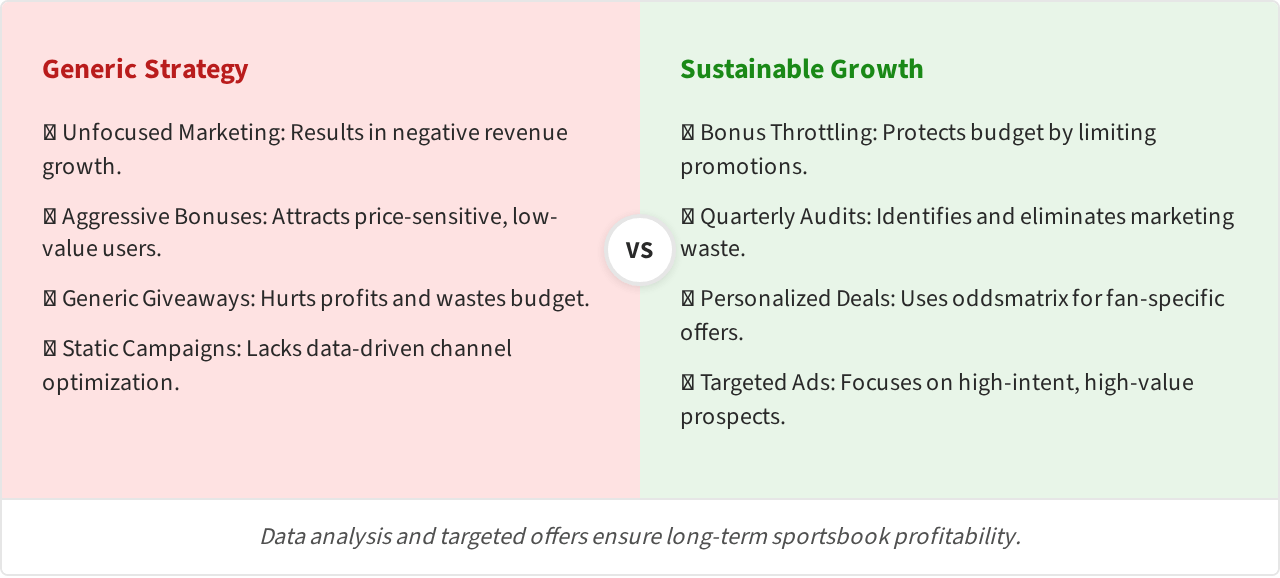
To grow your online sportsbook, check every marketing channel quarterly to find waste. Use data from the sports betting market to apply bonus throttling.
This protects your budget and focuses on high-value customers instead of generic giveaways.
Good marketing requires understanding user behavior. Use targeted strategies to reach high-intent prospects.
An online sportsbook can use an oddsmatrix to offer personalized deals for fans. This builds a sustainable online sportsbook through referrals and high-performing offers.
Data analysis keeps sports betting efforts profitable as the market changes. Targeted ads and bonus throttling help ensure long-term growth.
- Perform a quarterly ROI audit across every digital marketing channel to identify and eliminate bonus-abuse patterns.
- Implement bonus throttling on current promotions to preserve the customer base from profit erosion during major events.
- Shift marketing budgets toward content that targets high intent prospects rather than broad, low-value audiences.
- Use personalization driven by an oddsmatrix to differentiate through promotions tailored for specific customer segments.
- Focus on a robust referral program to leverage existing user trust and reduce reliance on expensive advertising partners.
Fixing technical friction in the cashier funnel
Growth for an online sportsbook depends on the tech supporting the customer journey. Marketing drives traffic, but engineering must keep sports betting seamless on all mobile devices.
Optimizing the Cashier Funnel
The cashier is a critical point in the betting lifecycle where many sportsbooks lose potential customers due to failed transactions.
Conducting a diligent vendor search for payment orchestrators allows bookmakers to implement new tech stacks that feature payment cascading.
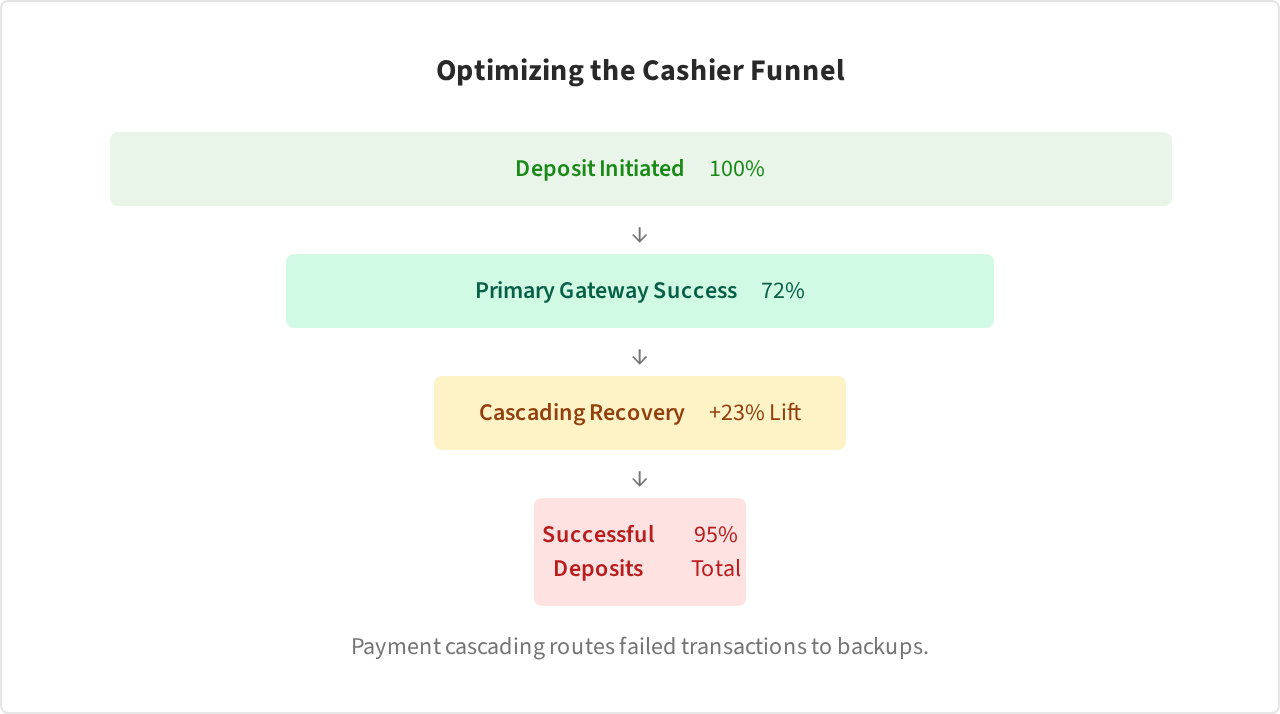
This capability routes transactions through multiple third party providers if a primary gateway fails, ensuring the online sportsbook remains always active.
Improving technology & engineering is essential for scaling a modern platform in a competitive market.
This automation reduces tedious operations for the backend team and ensures that accessibility and convenience remain priorities for those engaged in betting.
Enhancing mobile accessibility through these data solutions for bookmakers improves the initial deposit experience, directly impacting the long-term growth of the sports betting brand while maintaining product market fit.
Operators who innovate with technology often find that user friendly interfaces and intuitive platforms are more effective for retention than simple bonuses or broad marketing campaigns.
The Latency Threshold
In the realm of in play betting, the speed of live sports data is the most significant differentiator between elite sportsbooks and those with delayed responses.
High-quality sports data providers offer real time data that minimizes the gap between the event and the odds update, reducing the time spent in the action queue.
This speed is vital because the fast-paced nature of betting requires precision.
When bookmakers utilize advanced sports betting data services, they improve the bet acceptance rate and provide real time insight to their customers.
Utilizing an oddsmatrix integration or the integration of live sports data allows for operational transparency through centralized operational panels.
This control tower approach manages many moving parts, ensuring that personalization and market accuracy remain high during peak sports betting hours.
Furthermore, oddsmatrix helps operators in gamifying the platform by providing the granular data needed for interactive features.
By accessing sports betting data services that prioritize a consistent flow of real time data, companies can ensure personalization and efficiency are never compromised by technical lag.
| Operational Metric | Legacy Framework | Optimized Tech Stack |
|---|---|---|
| Deposit Success | Limited routing options | Dynamic payment cascading |
| Odds Transmission | Delayed responses | Real time data flow |
| User Experience | Tedious operations | Accessibility and convenience |
| System Uptime | Intermittent maintenance | Always active availability |
| Comparison of operational capabilities between legacy systems and modern tech stacks. | ||
Finding blue ocean profits in niche micro-markets
Traditional online sportsbook marketing fails by targeting broad audiences without differentiation.
Smart operators find growth in niche events like Dota 2 or auto racing.
Entering regional derbies creates a competitive edge that larger rivals miss. Smaller brands can use data to offer better odds than generic algorithms.
To grow, an online sportsbook must offer specialized wagers like bet builders for prop bets.
Using oddsmatrix feeds helps manage risk when entering new regions like New Jersey.
Better live commentary and quick reactions help an online sportsbook keep high margins. These tools also make it easier to manage esports betting next to traditional sports.
Use personalization to reach fans in sectors like esports betting. Success requires tailored solutions and local payment methods for different regions.
When an online sportsbook finds market gaps, it stops relying on costly incentives. Focusing on niche competitions helps an online sportsbook thrive.
Every sports betting platform must adapt to local needs to stay relevant.
- Prioritize dota 2 and other esports betting titles with high rising fan engagement to capture younger demographics.
- Implement local payment systems like PIX to improve conversion rates for customers in specific match ups.
- Utilize oddsmatrix data to manage risk accurately in auto racing and other niche sports competitions.
- Enable users to use bet builder tools for prop bets to increase engagement during live sporting events.
Advanced retention strategies for high-value players
CRM teams improve retention by finding loyal customers early in their journey. These tailored experiences help the online sportsbook grow through data and excitement.
Calculating True LTV
Calculating the compounding advantage of high frequency players requires player profiling through cohort analysis and machine learning.
In the competitive sports betting market, bookmakers must recognize that data is king for ensuring long term sustainability and a high return on investment.
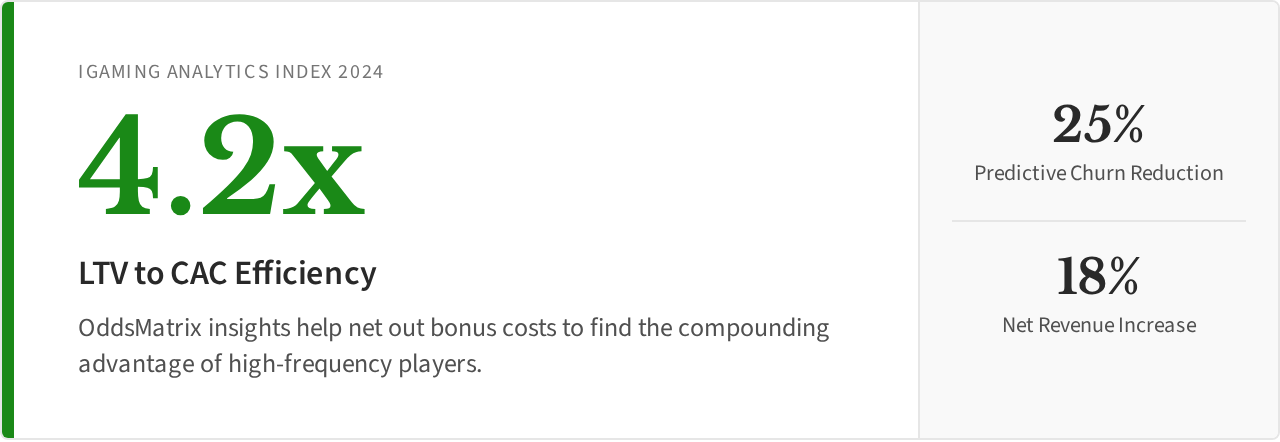
The formula for true player value must net out marketing expenses and bonus costs from the total revenue generated.
By using predictive churn models and predictive nudges, sportsbooks can protect their market share while offering a meaningful financial reward to those who provide better engagement.
These predictive models, supported by oddsmatrix tools, allow for a self funding system where the projected roi justifies initial spend through ongoing data sharing.
Developing a flywheel of trust with customers requires staff training and educating your audience on the value of their betting history.
When an online sportsbook integrates oddsmatrix insights, it creates a cycle of better engagement and growth.
This method ensures that every sports betting decision is backed by predictive analytics, turning raw data into a clear path for any sportsbook to scale.
To grow an online sportsbook sustainably, operators must treat high-frequency players as long-term assets—calculating true LTV (net of marketing and bonus spend) and deploying predictive churn models enables CRM teams to build self-funding retention loops that justify initial acquisition costs. Integrating odds- and behavior-driven analytics and investing in staff training creates a flywheel of trust and engagement that protects market share and scales revenue.
Head of Retention and Analytics
Implementing defensive scaling to protect your margins
Scaling an online sportsbook requires balancing marketing with a full risk management plan. Acquisition drives revenue, but high-volume markets threaten liquidity without careful oversight.
Automated Risk Profiling
Implementing risk management acts as a growth lever by allowing bookmakers to assess the risk factor manually or via automation.
By utilizing fraud prevention tools and systematic surveillance, sportsbooks can detect inconsistencies early and filter out fraudulent parties while optimizing their marketing strategy.
Modern sportsbooks use automated profiling to monitor its performance against professional syndicates while maintaining generous betting limits for recreational customers.
To mitigate the risks of bonus abuse, leading bookmakers are updating the risk management plan to include real-time verification steps.

Through regular internal audits and formal ongoing surveillance, you can set betting limits that accommodate sports betting volume without exposing the business to unnecessary risks or potential liabilities.
According to Gambling participation and problem gambling 2024, 35% of online gamblers have used at least one responsible gambling tool (like deposit limits) in the past 12 months.
Adhering to these responsible gambling standards is not just a compliance requirement but a core part of a personalization strategy that builds long-term market equity.
Monitoring betting patterns allows bookmakers to flag suspicious betting and react to sharp line movements before they impact margin preservation.
Proactive monitoring of operational risk ensures margin preservation through margin volatility alerts and a lower dispute ratio across your online sportsbook ecosystem.
Utilizing oddsmatrix data allows you to assess the risk factor and mitigate risk while managing markets that have already increased that risk through extreme volatility.
| Risk Category | Control Mechanism | Growth Benefit |
|---|---|---|
| Operational Risk | Formal ongoing surveillance | Stabilizes margin preservation by catching errors |
| Professional Bettor | Automated betting limits | Protects liquidity for recreational customers |
| Regulatory Compliance | Responsible gambling standards | Reduced intervention from regulatory bodies |
| Data Integrity | Systematic surveillance of feeds | Ensures accurate odds for professional bookmakers |
| Summary of critical defensive scaling mechanisms for sportsbook operations | ||
Why NGR determines the survival of your sportsbook
Tracking Gross Gaming Revenue is often misleading because it ignores bonus costs and taxes.
Success in the sports betting business requires a KPI playbook that focuses on profit, not volume.
Marketing teams might cheer for high GGR, but a negative NGR shows a flawed bonus ratio. Experts must check these bets against internal standards to stop bonus abuse.
Segmenting customers by value allows for growth tactics that prioritize Net Gaming Revenue. This focus keeps the operation viable in a crowded market.
An online sportsbook needs a clear reporting structure to link marketing spend to yield.
When the sports betting industry hits certain wager limits, operators should move from white-label to proprietary systems.
This migration allows bookmakers to use an OddsMatrix for better price control. Operators must also track traffic sources and use expert pricing to stay competitive.
Personalized customer experiences improve performance and create a more focused market strategy.
Trading teams must use data to handle line movement and live risks. An online sportsbook should use margin heatmaps to find pricing leaks and protect profits.
Using reliable odds keeps the sports betting business competitive and consistent. After migration, live trading with real-time data drives NGR.
Scrutinizing data this way separates top bookmakers from those only chasing volume.
- Monitor Net Gaming Revenue to detect unsustainable bonus burning and player acquisition costs.
- Utilize margin heatmaps to pinpoint exactly where pricing decisions leak profit to sharp bettors.
- Consider migration and expansion when white-label revenue shares exceed the cost of proprietary maintenance.
- Leverage real time data to ensure internal consistency and more accurate line movement adjustments.
Conclusion
To grow your online sportsbook, audit your data flows now. These audits help bookmakers manage intent peaks during high-pressure situations when big bets are placed online.
While some compare the online sportsbook market to tobacco or alcohol, growth requires fixing public health issues.
Advocates note that addiction rises after legalization, so enforced breaks are essential. Using sports betting 101, OddsMatrix provides data for personalization to keep gambling a safe hobby.
Use small, fast experiments to refine marketing and personalization via OddsMatrix. Avoid unchecked industries while scaling among online sportsbooks and bookmakers.
The future of gambling depends on active steps to monitor addiction after legalization. With support from experts, sports betting remains safe through disciplined bets and health monitoring.
Frequently Asked Questions
How can operators accurately calculate player lifetime value to optimize their marketing spend?
Calculating true Lifetime Value (LTV) involves analyzing the relationship between the average bet, margin, and the frequency of activity against the cost of acquisition and bonuses. Operators must look beyond registration counts and focus on Net Gaming Revenue (NGR) to understand which digital marketing channels are delivering profitable players. By utilizing refined marketing tools and behavioral sequencing, sportsbooks can identify users who represent long-term value rather than those who simply exploit sign-up incentives. This data-driven approach allows for better allocation of marketing budgets toward high-performing offers that support sustainable growth.
What role does risk management play in protecting the bottom line during rapid scaling?
Risk management is a critical growth catalyst because it allows a sportsbook to increase its volume without inadvertently exposing the house to catastrophic losses from sharp action or bonus abuse. Effective scaling requires the implementation of margin heatmaps and automated trading tools to monitor line movement in real-time. By using reliable odds from an oddsmatrix and maintaining internal consistency across various betting types, the research team can identify exactly where price bands are leaking value. This level of technical scrutiny ensures that as the sportsbook market evolves, the operator can maintain high hold margins and protect their Net Gaming Revenue.
How can improving the cashier funnel performance directly impact an online sportsbook growth rate?
The cashier funnel is often a hidden bottleneck where potential growth is lost to technical friction and poor deposit success rates. To grow your online sportsbook, it is essential to audit the payment journey and identify where players are dropping off during the transaction process. Integrating hyper-local payment methods for customers and utilizing a multi-processor payment gateway can significantly reduce abandonment. When players encounter a seamless deposit experience, the conversion rate of high-intent prospects improves, directly translating technical investments into increased revenue momentum and a more robust online presence.
Why should bookmakers prioritize niche betting markets instead of competing for broad audience segments?
Focusing on niche markets like esports betting or specialized sports competitions allows smaller operators to establish a credible competitive advantage without the massive marketing spend required for major leagues. While global bookmakers focus on generic sports betting, smart operators identify market gaps in areas like dota 2 or regional tournaments where they can provide deeper market coverage and more accurate pricing. Using oddsmatrix feeds to offer specialized types of wagers like prop bets in these micro-markets creates a unique selling point that attracts sophisticated bettors and maintains higher margins than standard, highly competitive markets.
What are the key technical challenges when migrating a sportsbook platform to support higher betting volumes?
Technical migration is often necessary to overcome growth plateaus and address inefficiencies that stall sportsbook momentum. As betting volume increases, operators must ensure their infrastructure can handle intent peaks without latency in data feeds or bet rejection. This phase typically involves moving toward a data-driven setup that supports personalization and advanced sports betting analytics. By refining the technical stack post-migration, bookmakers can implement better bonus throttling and risk management protocols. This technical evolution ensures that the platform can scale into new territories while providing the reliable odds and millisecond responsiveness that modern users expect.