


Fintech Marketing Strategy: A Complete Guide for Scalable Growth

This guide covers the full strategy stack: growth stage frameworks, channel prioritization, product-led growth, compliance guardrails, and retention. It includes analysis of what worked for Wise, Monzo, Revolut, Stripe, and Robinhood, plus the framework Fortis Media uses with its fintech clients.
What Is a Fintech Marketing Strategy?
A fintech marketing strategy is a coordinated system that explains complex financial products in plain language, builds credibility in a tightly regulated category, and turns educated readers into paying users. Beyond the standard digital marketing toolkit, it requires regulatory awareness (FINRA Rule 2210 in the US, FCA FinProm in the UK, SEC Marketing Rule for advisers, GDPR and PCI-DSS for data handling), longer feedback loops, and content that doubles as both an SEO asset and a compliance-approved sales tool.
Here’s the comparison of fintech marketing against traditional finance and crypto marketing campaigns:
| Niche | Key focal areas | Main challenge |
| Fintech | Build trust through educational content and compliance. | Navigating fintech regulations and staying patient through long sales cycles. |
| Traditional finance | Increase brand awareness and boost physical branch presence in the local market. | Adapting service offerings and integration capabilities to digital channels. |
| Crypto | Establish a loyal community and ride the hype of crypto market trends. | Sustaining retention and credibility through extreme price volatility. |
Fintech moves faster than traditional finance but demands more credibility than crypto. That tension is why many B2B fintech operators partner with a specialist fintech SEO agency rather than try to build the function entirely in-house.
If your in-house team is still developing its category expertise, a fintech-focused agency can compress the learning curve. The right partner brings compliance fluency, channel benchmarks, and a tested approach to fintech content marketing while your team absorbs the playbook.
Fintech Marketing Strategy by Growth Stage
The most common fintech marketing mistake is running a scaling-stage strategy at seed stage, or a seed-stage strategy when you should be scaling. The channel mix, budget allocation, and content priorities look completely different depending on where you are.
| Stage | Priority | What works | What to avoid |
| Pre-PMF | Validate product-market fit with a small audience | Community building, founder-led PR, direct outreach, waitlists | Paid acquisition before retention is proven |
| Post-PMF / Series A | Prove repeatable acquisition | SEO, performance marketing, referral loops, content | Brand campaigns without conversion infrastructure |
| Series B and beyond | Scale what works, build brand moat | Paid scale, brand campaigns, partnerships, ASO | Spreading budget across channels without clear CAC benchmarks |
Pre-PMF fintech brands should not be running Google Ads. They should be in Slack communities, getting covered in Sifted and AltFi, and building a waitlist that validates demand before acquisition spend begins. Monzo did this with its card waitlist. Wise grew through word of mouth before it spent heavily on performance. Revolut built a community before it built a paid media function.
Series A is where performance marketing and SEO start working together. Content builds the organic trust that paid campaigns rely on to convert. Running both without alignment means paying twice for the same user journey.
Series B and beyond is where brand investment makes sense, ASO becomes a meaningful lever for consumer apps, and partnership or embedded finance distribution opens new acquisition channels that neither paid nor organic can reach.
Why Fintech Marketing Is Different
Promoting a fintech product is fundamentally harder than marketing a typical app. You are asking users to connect bank accounts, move savings, share government IDs, or sign up for credit. That ask raises the bar on trust, copy review, and channel strategy.
On top of that, fintech marketing budgets are constrained not just by resources but by regulation. A campaign that works in SaaS may require FCA compliance review, legal sign-off on claims, and platform-specific certification before it can run in fintech. That adds time and cost that most marketing playbooks do not account for.
Four structural realities shape every fintech campaign:
- Trust and credibility come first. Users rarely try a financial product on impulse, and a single negative review thread can stall acquisition for weeks. Security messaging, third-party audit badges (SOC 2, ISO 27001), regulator licensing logos, and authentic social proof have to be visible everywhere — not buried in a footer.
- Strict industry regulations can limit your content rollout. Marketing copy needs legal review before launch and must comply with both regulator rules and platform-specific policies (Google Ads’ financial products certification, Meta’s regulated goods guidelines). Wording around “guaranteed returns,” “FDIC-insured,” or “risk-free” is a fast path to disapproval or fines.
- Complex financial services require a patient, educational approach. To gain user trust across diverse audiences, you must be able to make your app’s concept easy for them to understand. This would require incredible patience on your part, as you need to provide content marketing services for each stage of the buyer journey. This is especially true across fintech sub-verticals: a payments company, a wealthtech platform, and an insurtech product have fundamentally different user education needs and conversion timelines.
- Longer decision-making time requires multiple touchpoints. Individual consumers and high-intent users take more time to compare options and read reviews. You need multiple ads, follow-ups, and consistent educational content to boost visibility in the fintech space.
Key Components of a Fintech Marketing Strategy
The components below apply across growth stages, but how you weight them shifts significantly depending on whether you are pre-PMF, scaling, or operating at Series B and beyond.
Target Audience and Segmentation
Fintech founders have already defined their target audience to raise funding. What they need at the marketing stage is channel-level execution guidance, not persona frameworks. The question is not who your user is. It is where they research, what they search for, and what moves them from curious to signed up.
- Categorizing your target audience: Your lead generation efforts focus on B2C (selling to individual consumers) or B2B (selling to businesses). The distinction goes beyond audience type. B2C fintech converts through organic search, paid social, and referral loops. B2B fintech converts through SEO, LinkedIn, review platforms like G2 and Capterra, and a sales-assisted process that content supports rather than replaces.
- Understanding user behavior and intent: Different fintech sub-verticals attract different user intent patterns. Payments users search for speed and cost comparisons. Lending users search for eligibility and rate information. Wealthtech users search for safety, returns, and regulatory status. Insurtech users search for coverage specifics and claims processes. Content and channel strategy needs to reflect these differences, not treat “fintech” as a single audience.
Value Proposition and Messaging
Value proposition refers to the main reason why a customer should pick your fintech product over a traditional bank or another app. It’s a major part of brand storytelling, and could help you create an emotional connection with your audience.
- Simplifying complex financial products through helpful content: Replace “automated liquidity management” with “moves idle cash into higher-yield accounts overnight.” Replace “AI-driven underwriting” with “approves SMB loans in 90 seconds.” Visuals, animated explainers, and short product demos accelerate comprehension.
- Lead with radical transparency: Open communication from leadership, founder LinkedIn posts, public roadmaps, and transparent fee breakdowns outperform polished corporate messaging in a category where users have been burned by hidden fees and surprise charges.
Three fintech brands that got messaging right, and why:
- Wise built its entire brand around the “hidden fees” message. Rather than competing on features, it made the bank’s marked-up exchange rate the villain. The campaign was specific, provable, and directly relevant to the decision users were making. It earned press coverage and word-of-mouth at a fraction of the cost of brand advertising.
- Monzo’s “hot coral card” turned a product detail into a brand signal. In a category of grey and navy bank cards, a bright coral card was a conversation starter. Every time a Monzo user paid in a coffee shop, it was a word-of-mouth moment. Brand differentiation through product design, not advertising spend.
- Stripe’s developer-first GTM skipped the CMO entirely. By making the API documentation genuinely excellent and the developer experience frictionless, Stripe turned engineers into advocates. The product was the marketing channel. This is the definition of product-led growth.
Product-Led Growth in Fintech
Product-led growth (PLG) is the dominant growth model for consumer fintech, and it is almost entirely absent from most marketing strategy guides. Revolut’s free tier, Wise’s transparent pricing page, Stripe’s developer documentation, and Monzo’s waitlist were all PLG mechanics, not marketing campaigns.
PLG in fintech works because the product itself can demonstrate trust in a way that advertising cannot. When a user sees their actual transfer cost compared to the bank rate on a Wise page, that is more persuasive than any paid ad claiming “we’re cheaper.”
PLG mechanics that work in fintech:
- Freemium tiers. Revolut grew its user base on a free account with visible upgrade prompts. The free product was good enough to demonstrate value; the paid tier was clearly better. Users converted when they hit limits, not because of a sales email.
- Transparent pricing tools. Wise’s exchange rate calculator is a PLG asset that also ranks for high-intent SEO queries. It serves acquisition, conversion, and trust-building simultaneously.
- Referral loops. Revolut, Monzo, and Wise all built referral programs that turned existing users into acquisition channels. In consumer fintech, where trust is scarce, a recommendation from a peer outperforms any paid channel. Revolut grew to 500,000 users primarily through referrals before significant paid spend.
- Developer documentation as a growth channel. For B2B fintech, documentation that ranks for developer-intent queries drives pipeline from engineers who have direct influence over product selection. Stripe’s docs are the clearest example, but the model applies to any fintech product with an API or integration layer.
Channel Strategy
Multi-channel visibility is a scaling-stage goal. At seed and early growth stage, one proven channel is worth more than five partially funded ones.
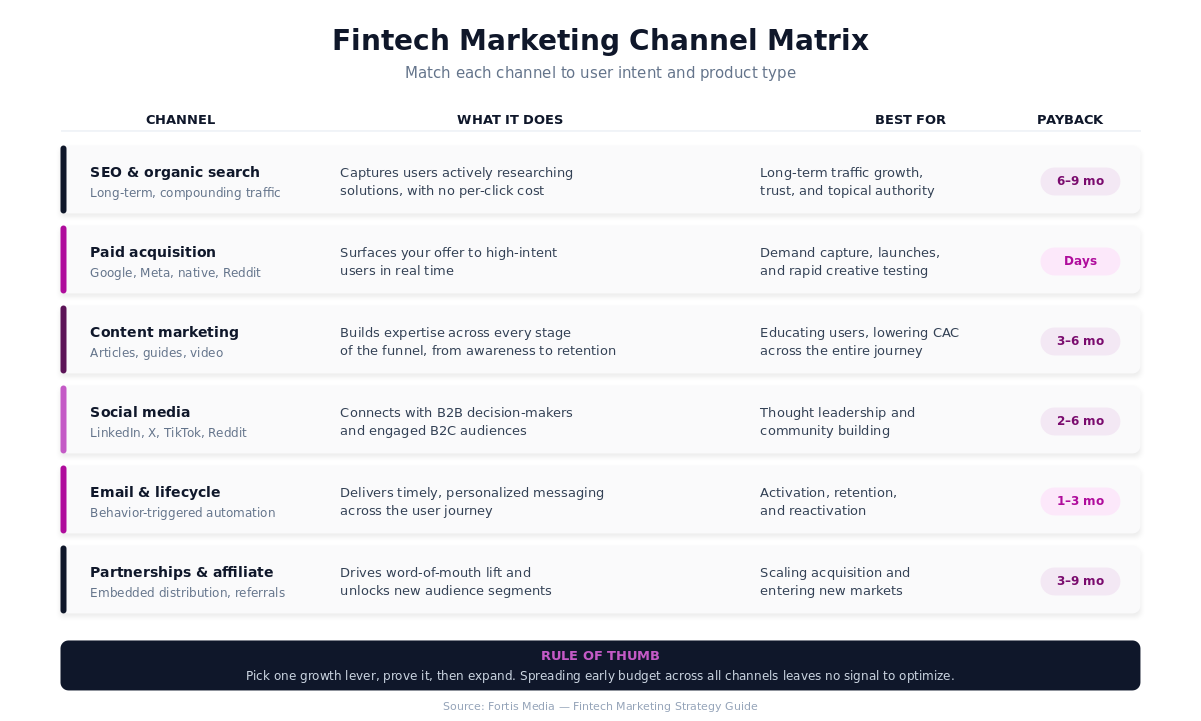
- Choose your mix deliberately. Common fintech channels include organic search, paid acquisition, email and lifecycle, social, communities, partnerships, and PR. Allocate budget across paid and organic with a clear-eyed view of payback periods. At pre-PMF: PR and community. At Series A: SEO and performance. At Series B and beyond: brand, ASO, and partnerships.
- Match channel to intent and product type. Social discovery surfaces new brands; SEO captures comparison-stage users; B2C apps lean on paid social and creator partnerships; B2B tools win in SEO, LinkedIn, and review-site placement (G2, Capterra). Comprehensive SEO services typically anchor B2B fintech strategies because the buying committee researches independently. For consumer fintech apps, App Store Optimization (ASO) is a channel that is consistently underinvested. A well-optimized App Store listing with strong reviews and keyword-rich copy captures high-intent users at the moment of download intent, at zero incremental cost.
- Referral and viral loops are foundational for consumer fintech, not optional extras. Revolut, Wise, and Monzo all grew faster through referral than through paid acquisition in their early years. A referral mechanic built into the product from day one compounds in a way that no paid channel can replicate.
- Partnership and embedded finance distribution opens acquisition channels unavailable through direct marketing. Getting your product embedded in an accounting platform, an HR tool, or a payroll system puts it in front of users at the exact moment of financial need, without competing for search traffic or ad spend.
Content and Education Strategy
In fintech, content is the most efficient sales tool you have. If your brand cannot demonstrate expertise, no amount of paid media will close the trust gap.
- Removing fear through helpful content: Simple, step-by-step guides and user testimonials show people that your app is safe and easy to use. Plus, people see you as an expert when you explain a topic in a way that they can easily understand.
- Producing content types that work in fintech: High-performing formats include head-to-head comparison pages, technical guides, regulatory glossaries, anonymized case studies, video walkthroughs, whitepapers, and customer success stories. Strong content marketing services tie each format to a specific funnel stage.
Conversion and Funnel Optimization
The fintech marketing funnel is slower than most because it is interrupted by KYC, AML, and identity-verification steps. Friction at any of these moments compounds drop-off, so the work is to remove obstacles, not just optimize CTAs.
- Optimizing landing pages and User Experience (UX): Plain-language headlines, scannable proof points, mobile-first design, and unmistakable CTAs are non-negotiable. Sub-2-second page loads and instant form validation materially improve completion rates.
- Reducing user difficulties at every stage: Shorten signup forms, pre-fill where compliance allows, surface progress indicators during verification, and add trust signals (regulator licensing, third-party security audits, customer ratings) directly above conversion CTAs.
Retention and Lifecycle Marketing
Fintech CAC is expensive, so lifetime value is what determines whether your unit economics work. Lifecycle marketing — sending the right message at the right time to the right cohort — is where margin gets made.
- Use the right stack: Email, in-app messaging, push, CRM platforms (HubSpot, Customer.io, Braze), and product analytics (Amplitude, Mixpanel) work together to automate workflows and surface behavioral signals.
- Lift LTV deliberately: Milestone rewards, educational newsletters, referral loops, and well-timed cross-sells (a checking-account user nudged toward investing once their balance crosses a threshold) compound over time. The longer users stay and the more features they adopt, the higher the LTV-to-CAC ratio.
Financial Promotion Compliance in Fintech Marketing
Most fintech marketing guides cover channels and tactics. Almost none cover the operational constraint that shapes every campaign: financial promotion compliance. A marketing strategy that ignores this is incomplete.
In the UK, FCA financial promotion rules require that all fintech marketing communications are fair, clear, and not misleading. In the US, FINRA Rule 2210 and SEC Marketing Rule apply equivalent standards.
Pre-publication checklist for fintech marketing content:
- Claims must be substantiated. “The fastest transfers” requires data. “No hidden fees” requires a full fee disclosure. “Best savings rate” requires a comparison source and date.
- Risk warnings must be present where required. Investment-adjacent content, BNPL promotions, and credit products all have specific disclaimer requirements that vary by jurisdiction.
- Fair balance is mandatory. A promotion that leads with benefits must give adequate prominence to relevant risks. Burying a risk warning in a footer does not meet fair balance requirements.
- Approval workflow required. In the UK, financial promotions must be approved by an FCA-authorized person before publication. This applies to blog posts, social media, and paid ads.
- Platform policies layer on top of regulatory requirements. Google Ads requires financial products certification. Meta has regulated goods guidelines. Both can disapprove compliant-by-regulation content if it violates platform-specific rules.
Building a compliance review step into the content production workflow before launch, not after, is the operational difference between fintech marketing teams that scale cleanly and those that spend time correcting published work.
Best Marketing Channels for Fintech Companies
Fintech Marketing Funnel Explained
The fintech funnel maps a potential user’s journey from problem awareness to an active, retained customer. Because users are deciding whether to trust your brand with their money, the funnel typically has lower conversion rates than other industries and demands more proof at each stage.
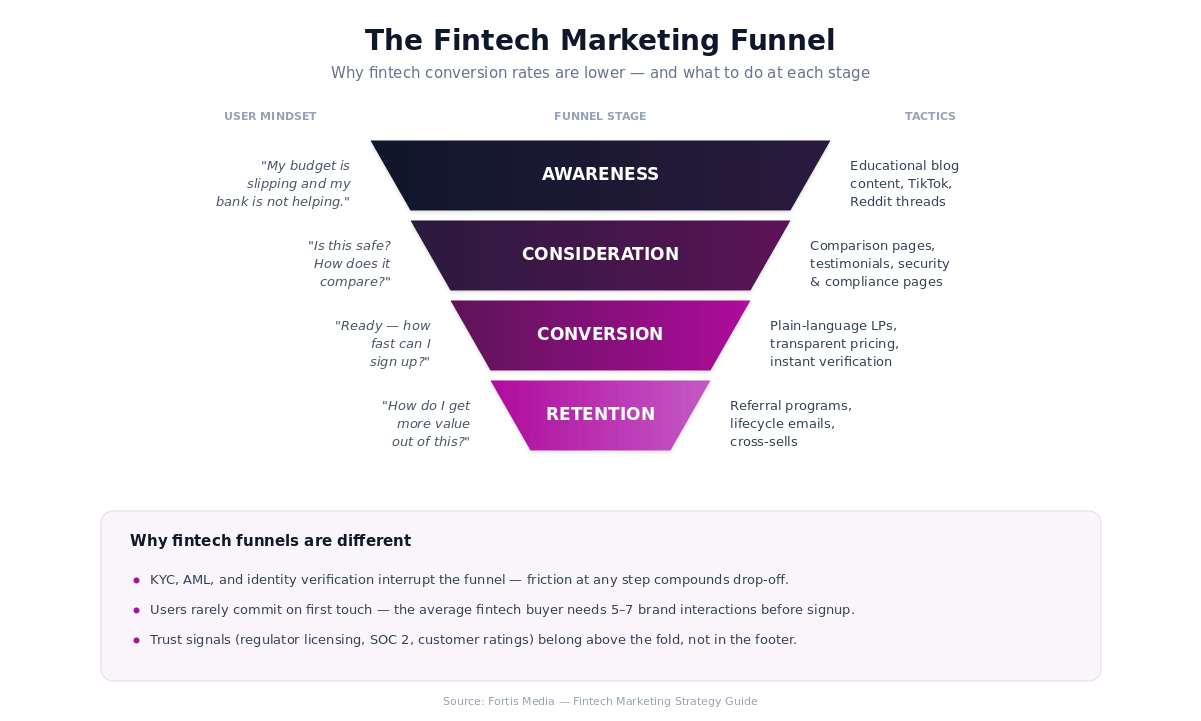
Fintech funnels sell safety and certainty, not just convenience. If users drop off before signup, the typical culprits are friction-heavy forms, weak social proof, or unclear pricing. The next sections cover those mistakes in detail.
Fintech Marketing Strategy Examples
The brands below did not just pick good channels. They built growth engines that matched their product, stage, and audience. Here is what each one actually did and why it worked.
- SEO-led growth playbook: Wise built a multi-million-visit organic moat with country-pair landing pages and currency calculators. The key was specificity: not “how international transfers work” but “send money from the UK to Poland, here is the exact cost and exchange rate.” That level of detail earned links, ranked for high-intent queries, and converted users at the point of decision. Ramp scaled its organic footprint by publishing high-utility finance ops content. This approach requires a recurring SEO audit cadence to maintain technical health, plus disciplined link building services to compete in a YMYL category where domain authority drives rankings.
- Paid acquisition and landing page funnels: Robinhood and Cash App rode targeted paid social and high-conversion landing pages to break out. The model only works when CAC and payback periods are tracked tightly; fintech ad costs on Google and Meta routinely exceed $50 per qualified click in competitive segments, which is why dedicated PPC services with category experience matter.
- Education-first strategy: NerdWallet and Investopedia built audiences by teaching financial concepts before recommending products. Newer operators like Public and Betterment use the same playbook with explainer video, glossary content, and creator partnerships. The compounding effect is significant: educational content that ranks organically reduces paid acquisition dependency over time.
- Community-led growth: Revolut and Monzo invested early in user communities (forums, Discord, in-app feature voting). Monzo’s hot coral card turned every in-person payment into a word-of-mouth moment. Revolut grew to 500,000 users primarily through referrals before significant paid spend began. Loyal communities reduce support cost, surface product ideas, and produce a steady flow of authentic advocacy that paid channels cannot replicate.
How to Build a Fintech Marketing Strategy
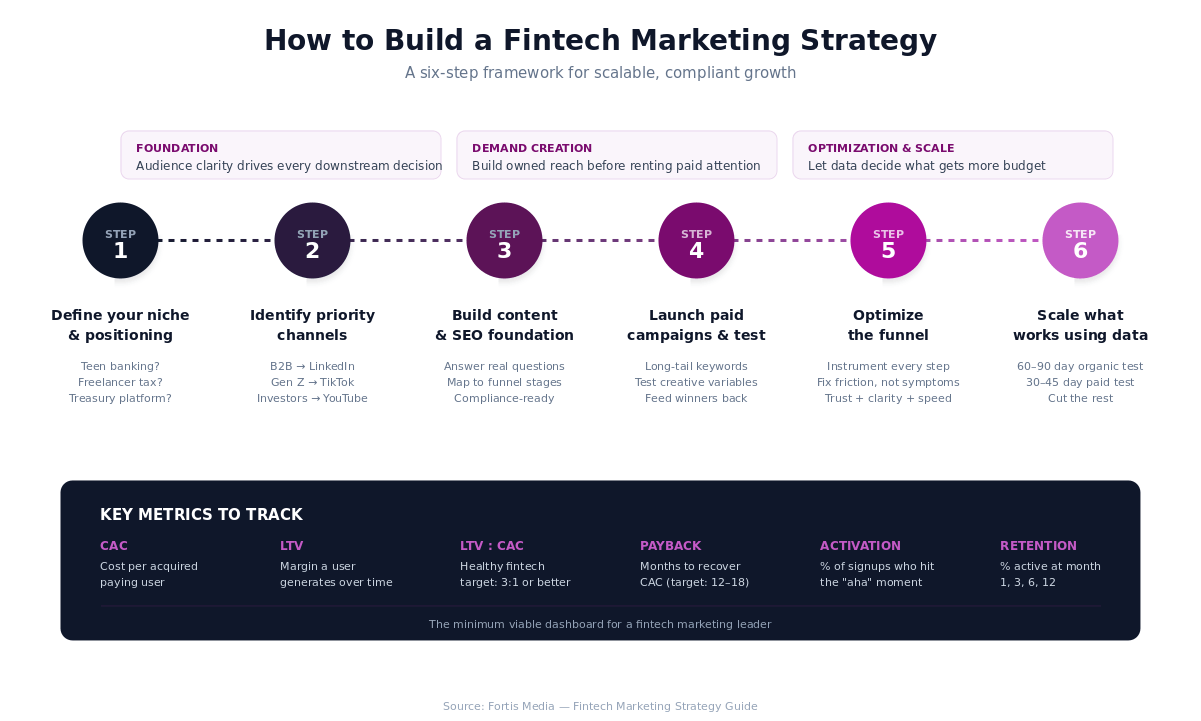
The six steps below are a starting framework, not a template to copy. Treat them as guideposts and adapt them to your category, stage, and competitive position.
Common Fintech Marketing Mistakes
These are the mistakes that compound quietly until they become expensive:
- Treating fintech like a simple app: Fintech isn’t the same as a food delivery or game app. Your messaging has to address security, regulation, and real financial outcomes, not just convenience.
- Ignoring compliance and trust signals:Regulator licenses, audit badges, deposit-protection notices, and verified customer reviews belong above the fold, not in the footer. A financial promotion that does not meet FCA fair balance requirements or lacks required disclaimers is not just a compliance risk. It is a campaign that can be pulled mid-flight.
- Over-focusing on traffic instead of conversions: Traffic means less if users leave your page without signing up. Always review your landing pages and fix any friction points.
- Weak funnel and onboarding experience: Buggy KYC flows, redundant document uploads, and slow verification kill conversion. Walk through your own signup on a low-end Android device monthly.
- Lack of channel integration: When SEO, paid, email, and social tell different stories, brand recognition suffers and CAC climbs. A shared messaging matrix keeps every channel pointed at the same proof points.
- Ignoring growth stage. Running a scaling-stage channel mix at seed stage wastes budget on acquisition before retention is proven. Running a seed-stage strategy at Series B leaves growth on the table. The channel priorities in the sections above are stage-specific for this reason.
Key Metrics to Track in Fintech Marketing
Traffic is not on this list. These are the metrics that reflect whether the strategy is actually working:
| Fintech marketing metric | What it means | Why it matters |
| Customer Acquisition Cost (CAC) | Total cost to acquire one paying user, blended and by channel. | Shows how much you need to spend to grow your user base. |
| Customer Lifetime Value (LTV) | Total margin a user generates across their tenure. | Shows how much each user is worth. |
| LTV-to-CAC ratio | LTV divided by CAC. | A healthy fintech business typically targets 3:1 or better. |
| Conversion rates | Percentage of visitors who complete each funnel step. | Pinpoints where the funnel leaks. |
| Payback period | Months required to recover CAC from a user. | Shows how aggressively you can scale acquisition. |
| Activation rate | Percentage of signups who complete the “aha” action (first transfer, first deposit, first invoice paid). | The single best leading indicator of retention. |
| Retention cohorts | Percentage of users still active at month 1, 3, 6, 12. | Confirms whether the product delivers durable value. |
How Fortis Media Builds Fintech Marketing Strategies
Fortis Media has spent more than 13 years building organic and paid acquisition systems for regulated industries, with fintech clients including Genome and Skilling. Across the agency’s portfolio of 80+ websites, the work delivers an average of 149.87% year-over-year organic growth, more than 20 million organic sessions, and a 90% client retention rate.
Our work with fintech clients centers on four principles:
- Numbers-first mindset. Every channel is tracked to revenue, not just signups. Clients receive transparent dashboards with CAC, LTV, payback, and channel-level contribution margin.
- Multi-channel orchestration. We balance SEO, content, paid, and lifecycle so you are not over-reliant on a single channel. Diversification protects against algorithm changes and platform policy shifts that hit fintech harder than most categories.
- Fintech and crypto category experience. Our team has shipped campaigns under FINRA, FCA, MAS, and EU regulatory regimes, and works fluently with clients’ legal and compliance reviewers.
- Scalable acquisition systems. New channels are tested at small scale, then expanded based on payback math. We size investment to the data, not the hype.
That partner-led approach is why Oksana Arbaciauskaite, CMO of Genome, describes the engagement this way: “Fortis Media goes above and beyond. Their dedication to offer solutions for our complex problems sets them apart. It’s not just about pushing services – they invest time to look for industry-specific solutions and positive change opportunities.”
Our view on channel prioritization: for most early-stage fintechs, organic search combined with product-led growth delivers stronger long-term LTV than paid acquisition at significantly lower cost per user. Paid media scales well after organic and referral loops are proven. Brands that invert this sequence typically find CAC rising as they scale, not falling. Get a Proposal to discuss what the right sequence looks like for your growth stage.
Frequently Asked Questions
How long does it take to see results from fintech marketing?

Paid ads can drive signups within days, but organic growth through SEO and content typically takes six to nine months. Fintech users need more touchpoints than most categories before they trust a brand with their money.
Is influencer marketing effective for fintech brands?
Yes, with the right creators. Micro-influencers in personal finance (10,000 to 100,000 followers) consistently outperform broad lifestyle creators because their audiences treat their recommendations as peer advice, not advertising.
How do fintech brands handle marketing compliance?
All fintech marketing communications must go through a compliance review before publication, covering claim substantiation, required disclaimers, and FCA or equivalent regulatory standards. Building this as a standard editorial step, not a final check, keeps campaigns live and avoids costly corrections after launch.
Is social media effective for B2B fintech marketing?
Yes, with platform discipline. LinkedIn is the dominant channel for B2B fintech, and the content that works is data-driven: anonymized benchmarks, customer ROI breakdowns, and concrete product walkthroughs that help a buyer build the internal business case.
What is a typical CAC for a fintech startup?
Consumer fintechs often see CAC ranging from $20 to $200, while B2B fintech CAC can run from $500 to $5,000 or higher for enterprise deals. The more important number is the LTV-to-CAC ratio, where 3:1 or better with payback inside 12 to 18 months is the benchmark to target.
Should fintechs use TikTok?
For consumer fintech serving Gen Z or millennial audiences, yes – but with a creator-led approach rather than polished brand spots. The platform rewards authentic explainer content (how a feature works, what a fee structure means, why a tax rule changed). For B2B fintech, TikTok is rarely the right primary channel.
How should a fintech allocate budget between paid and organic?
A common starting allocation is 60 to 70 percent paid and 30 to 40 percent organic in year one, shifting toward a more even split by year three as SEO and content compound. The exact ratio depends on category competitiveness, sales cycle length, and existing brand equity.


Read our other articles
B2B SEO Services: Are They Worth Your Investment in 2026?

Top 15 SaaS Marketing Automation Tools for Streamlining Your Business in 2026
Creating a Winning SaaS Marketing Strategy in 2026: Your Complete Guide