


Do Broken Links Affect SEO? How To Optimize Your Links

Broken links are a normal part of the web: pages get renamed, content gets retired, and legacy URLs keep getting clicked. The real question is, do broken links affect SEO enough that fixing broken links deserves ongoing attention?
Google’s John Mueller has been consistent: a true “page not found” response is not, by itself, a sitewide penalty.
“404s/410s are not a negative quality signal. It’s how the web is supposed to work.”
So, do broken links affect SEO? Directly, not in the sense of “Google sees a few broken links and drops your rankings.”
According to SEO platforms like Ahrefs and Semrush, broken link building works because website owners are often unaware that their pages contain dead links pointing to content that no longer exists.
Indirectly, broken links affect SEO when they create a dead end for users, waste crawl budget, or break internal link paths that help search engines crawl and understand your other pages.
When broken links affect SEO and when they don’t
A site with a handful of broken links is typically fine. But broken links affect SEO when they appear in high-traffic areas or at scale.
Broken internal links are the biggest self-inflicted issue. If your navigation, footer, or related-content modules contain broken internal links, thousands of pages can end up pointing to non-existent pages. Those broken links create repeated dead-end experiences and can turn useful internal links into “wasted clicks”.
Externally, an inbound old link to a legacy URL can still matter. Google will not index a URL that returns a 4xx status code, and a previously indexed 4xx URL is removed over time.
If that legacy URL has valuable links pointing at it, letting it sit as a 404 can mean losing the opportunity to route that user (and any remaining link signals) to the intended destination.
If the original page is truly gone and unimportant, a correct 404/410 is fine.
How broken link building works
The broken link building process typically follows three core steps.
First, SEO professionals find broken links on external websites within their niche. These are often links pointing to pages that no longer exist, resulting in a 404 error.
Second, they ensure they have relevant content that matches the topic of the broken page. This is crucial because website owners will only replace the link if the new resource provides real value.
Finally, they reach out to the website owner to notify them of the broken link and recommend replacing it with a link to their own content.
The process can be summarized in the following workflow.
| Step | Action | Goal |
| 1 | Find broken links on external websites | Identify dead links that harm user experience |
| 2 | Match the broken link topic with relevant content | Provide a useful replacement |
| 3 | Reach out to the website owner | Suggest replacing the broken link |
Since both parties benefit, broken link building is often described as a “win-win” SEO strategy.
The website owner improves their content by removing dead links, while you gain a contextual backlink that strengthens your site’s authority.

How search engines interpret broken links
In practice, “broken links” is shorthand for what happens when a crawler follows links and hits a URL that can’t return the expected content.
From the HTTP standard, a 404 (Not Found) means the origin server did not find a current representation for the requested resource, and 410 (Gone) is preferred when the server knows the removal is likely permanent.
Google’s crawling documentation adds the operational detail that matters for SEO performance: Google ignores content from 4xx responses, doesn’t index those URLs, and removes already indexed 4xx URLs over time.
Search Console also surfaces crawl errors for 4xx—5xx responses and failed redirections (3xx).
| Technical outcome | Typical cause | What Google does | What you should do |
| Clean removal | 404 / 410 for a page that’s genuinely gone | Not indexed; dropped over time. | Leave it, but ensure users don’t hit it from broken internal links. |
| “Soft 404” | Page returns 200 but displays “not found” content | Can be flagged as a soft 404; Google recommends returning a real 404 for truly missing pages. | Fix templates and status codes; soft 404s are usually higher priority than real 404s. |
| Availability problems | 5xx server error bursts | Google slows down crawling when it sees server errors. | Fix infrastructure first; link hygiene comes after stability. |
Redirects: the right fix for the right broken links
Redirects are essential when content moves, but they can become a problem when used to “paper over” broken links.
Google’s redirect documentation explains that permanent redirects and temporary redirects send different signals: permanent redirects generally cause Google to show the new target in results, while temporary redirects tend to keep the source URL in results longer.
Google also treats permanent redirects as a strong canonical signal and temporary redirects as a weak canonical signal.
Redirect chains add another dimension: performance. PageSpeed Insights warns that multiple redirects add extra HTTP request-response cycles and can introduce additional roundtrips (DNS, TCP, TLS), delaying rendering — especially on mobile.
Lighthouse similarly notes that the extra network trip can delay loading by “hundreds of milliseconds.”
Since redirects and broken links delay rendering and interrupt journeys, many teams see this show up as a higher bounce rate in Google Analytics reports for affected entry pages.
Redirect chain vs direct redirect
Googlebot also has practical limits: by default, Google’s crawlers follow up to 10 redirect hops. So even if “it works in the browser,” long chains can become crawl bottlenecks.
A common point of confusion is whether redirects lose PageRank. Gary Illyes (Google) addressed that directly:
“30x redirects don’t lose PageRank anymore.”
So the best practice today is less “fear 302s” and more “match intent.” Use 301/308 when it’s permanent, and 302/307 when it’s genuinely temporary.
Fixing broken links and optimizing links end-to-end
Fixing broken links works best when you treat it like a workflow, not a one-off cleanup. The goal is to reduce broken links, reduce unnecessary redirects, and keep internal links pointing to the final URL.
Broken link building is a structured SEO strategy that turns dead links into valuable backlink opportunities. Instead of simply reporting broken links on other websites, SEO professionals provide a helpful replacement resource.
This process improves user experience, helps website owners maintain their content, and strengthens your own site’s authority.
The diagram below shows the typical broken link building workflow.
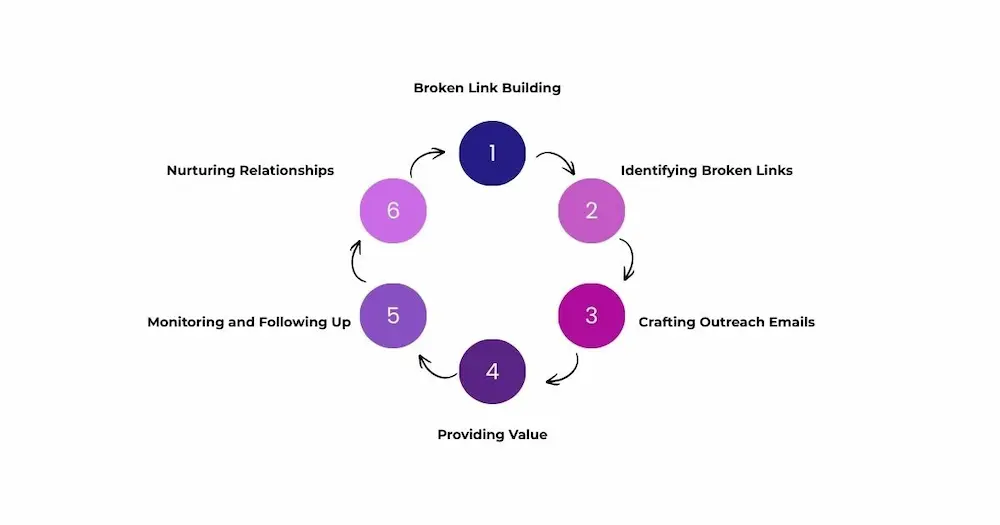
Step 1: Broken Link Discovery
The first step is identifying broken links on relevant websites within your niche.
SEO professionals use tools such as Ahrefs, Semrush, Screaming Frog and of course Google Search Console.
These tools help find dead links pointing to pages that no longer exist, often returning 404 errors.
Also, avoid “redirect everything to the homepage.” Martin Splitt (Google) was blunt when asked whether redirecting all 404s to the homepage can hurt: “Yes, and also it annoys me as a user.”
Step 2: Identifying Relevant Opportunities
Not every broken link is worth pursuing.
The next step is identifying broken links on websites that are relevant to your industry, have strong authority, and contain content related to your topic.
The closer the topic matches your content, the more likely the website owner will accept the link replacement.
Step 3: Crafting Outreach Emails
Once you find broken links and relevant opportunities, the next step is contacting the website owner.
The outreach email should politely inform them about the broken link, explain where the broken URL appears, and suggest your content as a helpful replacement.
This approach works because it helps the website owner fix a problem while improving their page.
Step 4: Providing Value
Successful broken link building focuses on value.
Your replacement content must match the topic of the original page, provide useful information, and improve the page where the link appears.
If the content is not relevant or helpful, website owners will ignore the outreach request.
Step 5: Monitoring and Following Up
Outreach rarely succeeds on the first attempt.
SEO teams usually track responses and send follow-up emails if necessary.
Monitoring also ensures that:
- The broken link is actually replaced
- The new backlink remains active
- Future relationship opportunities are maintained
Step 6: Nurturing Relationships
The final step in the broken link building process is relationship building.
When website owners respond positively, they often become valuable long-term partners.
This can lead to future guest posting opportunities, additional contextual backlinks, or collaborative content partnerships.
Over time, nurturing these relationships strengthens your link-building strategy and site authority.
Monitoring broken links with Google Search Console
Google Search Console should be your “source of truth” for how Google experiences your links.
The Crawl Stats report shows how many crawl requests were made, how your server responded, and whether Google encountered availability issues. Google also notes you usually don’t need to obsess over crawl budget unless you operate at large scale (for example, ~1 million+ unique pages, or 10,000+ pages that change daily).
This is where you connect broken links to crawl budget and to technical issues like spikes in redirects or server error responses.
The Links report in Google Search Console helps you understand which pages are heavily linked (internal and external). If an important legacy URL starts returning 404, this report helps you decide whether it’s worth fixing broken links with a targeted redirect or whether you should just remove references and let it drop.
When you deploy fixes, validate intelligently. Search Console notes that validating a subset of affected URLs (for example, filtered by a sitemap) can complete faster than trying to validate everything.
SEO Compliance: Why Fixing Broken Links Is Essential for Website Health
Maintaining SEO compliance is one of the most overlooked reasons for fixing broken links. While many website owners focus on content and keywords, search engines also evaluate the technical integrity of links across a website.
Broken links affect SEO because they signal that a website may not be well-maintained. When search engine bots crawl a site and repeatedly encounter broken URLs, dead links, or server errors, it interrupts the crawling process and reduces overall site efficiency.
Search engines such as Google and other search engines rely heavily on links to discover and understand content. Internal links help search engines understand the site structure, while external links provide context and authority signals. When these links break, the relationship between pages becomes unclear.
Conclusion
So, do broken links affect SEO? Not as a simple “important ranking factor,” but broken links affect SEO through user experience, link graph continuity, crawl errors, and crawl budget efficiency.
Fixing broken links is ultimately link optimization: keep internal links accurate, use redirects only when they preserve a real intent, minimize redirect chains, and monitor patterns in Google Search Console. Done consistently, you remove potholes from the user journey and keep search engines moving smoothly through your site.
If you want to strengthen your site’s authority and improve your link profile, professional help can make a big difference.
Learn more about contextual link building services here.
Fortis Media specializes in building high-quality contextual links that strengthen your site structure, improve search engine rankings, and support sustainable SEO growth.
FAQs
What is broken link building?

Broken link building is an SEO strategy that involves finding broken (dead) links on websites and suggesting replacing them with links to your own relevant content. Instead of leaving users with dead links that lead to non-existent pages, website owners can update the page with a useful replacement resource. This approach improves the user experience while also helping you earn a valuable backlink.
How does broken link building work?
Broken link building typically follows three steps. First, SEO professionals find broken links on websites related to their niche using SEO tools. Next, they ensure they have content that closely matches the topic of the broken page. Finally, they reach out to the website owner to report the dead link and recommend replacing it with their own content as a relevant resource.
Is broken link building considered white-hat SEO?
Yes. Broken link building is widely considered a white-hat SEO technique because it focuses on improving the web rather than manipulating search engines. By helping website owners repair broken links and replace them with relevant resources, the strategy follows ethical SEO practices.
What are the disadvantages of broken link building?
Although broken link building can be effective, it does have some challenges. The process can be time-consuming because it requires researching websites, identifying broken links, and conducting outreach. The success rate may also be low since many website owners do not respond to outreach emails. Additionally, the strategy is competitive because other SEO professionals may target the same broken links.
Why does content relevance matter in broken link building?
Content relevance is essential for successful broken link building. Website owners are much more likely to replace a dead link when the suggested replacement closely matches the original topic and provides real value to readers. If the content is not relevant or helpful, the link replacement request will usually be ignored.


Read our other articles
How to Stop AI Slop and How Digital Marketers Can Help

SEO Compliance Checklist for Regulated Gambling Sites

10 Gambling SEO Tips for Online Casinos and Betting Sites in 2026