
Gaming marketing has shifted from high-volume spending toward sustainable growth. Brands like DraftKings and BetMGM once spent millions on TV during the NFL season.
Rising costs forced a move toward digital.
Statista’s ‘Growth in Digital Betting Advertising’ report shows search engine ads for sports betting terms rose 33% YoY in 2025.
Efficiency now depends on ad tech instead of volume.
Modern campaigns must use strong ad servers and programmatic tools to compete for attention.
These platforms outperform traditional spots.
They help brands maintain awareness during major events without the diminishing returns of linear TV.
By using advanced ad tech and ad serving software, operators ensure long-term profit and growth in a changing business model.
Key Takeaways
- Operators should prioritize programmatic digital spending over linear television to ensure long-term marketing profitability.
- Targeting the January playoffs provides a higher return on investment than the expensive Super Bowl.
- Strategic compliance frameworks must navigate state restrictions using precise geo-fencing and automated metadata monitoring tools.
- Mid-market brands can gain market share by utilizing private marketplaces for localized niche sporting events.
- Transforming one-off bettors into loyalists requires personalized promotional sequences and sophisticated bonus management systems.
Strategic Compliance Frameworks for US Regulated Markets
Building a full compliance system helps legal operators follow the webinarcracking code while achieving measurable growth.
By turning fragmented attention into retention, brands prove they are ready for a techready liftoff in permissive jurisdictions.
Standard Creative Mandates
Legal, regulated sportsbooks must prioritize responsible gambling integration by including age verification prompts and mandatory problem gambling resources in every creative asset to satisfy gambling advertising compliance.
According to the UK Gambling Commission: Consumer Voice Research 2025, 85% of surveyed adults in the UK report seeing gambling advertisements on social media daily, highlighting why automated compliance management is vital for a new techready liftoff site.

This high exposure environment necessitates that compliance features and an advertising monitoring service are built into the creative workflow to maintain the integrity of legal operators.
Operators who master the webinarcracking code primetime requirements ensure their monitoring service remains robust, turning fragmented attention into trust through visible trust badges.
Using techready liftoff site tools, teams can reach new heightstogether social goals while maintaining automated compliance checking for all required disclaimers and problem gambling centers.
By ensuring every new advertisement meets the webinarcracking code primetime standard, brands create a sustainable measurable impact that resonates with players seeking secure, regulated environments.
Regulated Markets Differences
Navigating the webinarcracking of state-specific gambling advertising regulations is mandatory, as the american gaming association monitors how jurisdiction specific requirements vary across the country.
While some legal compliance support is critical in states like New Jersey and Ohio, which mandate stringent creative font-size standards for responsible gambling requirements, others rely on independent aga research.
A techready legal director must oversee regulatory reporting and audit trails to reach new heightstogether within these highly complex regulated markets, ensuring the brand remains compliant in regulated markets at all times.
By turning fragmented attention toward measurable growth, legal, regulated sportsbooks utilize built in compliance tools to manage data security and privacy requirements effectively.
Every techready liftoff must ensure its primetime advertising adheres to the webinarcracking code primetime rules to avoid heavy fines, while the webinarcracking of regional nuances provides new measurable opportunities.
This framework ensures that any techready operation can maintain compliance control while using responsible gambling as a key conversion and retention tool.
| Jurisdiction | Creative Requirement | Disclaimer Specifics |
|---|---|---|
| New Jersey | Strict Font Size | 10pt minimum font required for all responsible gambling footers |
| Ohio | Logo Prominence | Mandatory placement of universal RG logo on all digital banners |
| Pennsylvania | Age Iconography | Explicit 21+ circle icon must be visible for at least 3 seconds in video |
| Arizona | Resource Linking | Direct one-click access to state-specific problem gambling centers |
| Comparison of creative and disclaimer requirements for legal operators in key US regulated markets. | ||
Scoring Acquisition Efficiency During the NHL Playoffs
As the NFL season moves into the divisional round, operators see traffic spikes that rival the biggest events. Many brands focus betting advertising on the Super Bowl.
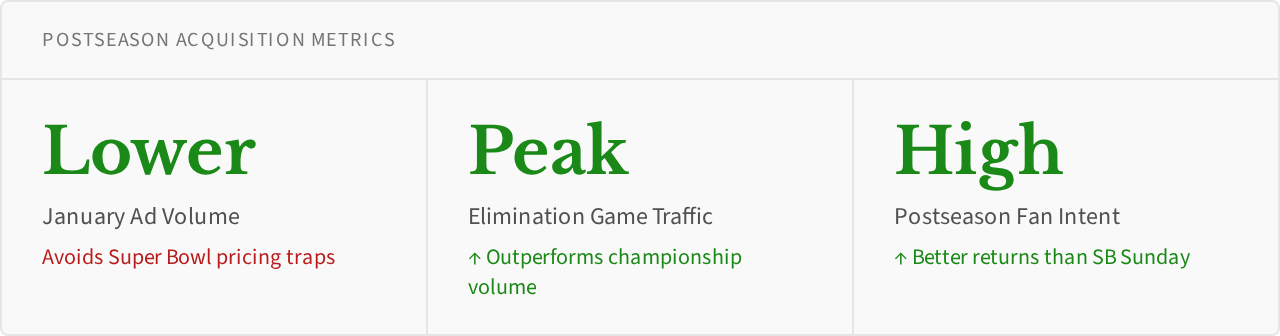
However, savvy operators use January playoff games as high-intent moments with lower advertising volume.
During the NFL and college playoffs, peak betting times offer better returns than the costs of Super Bowl Sunday.
By identifying these windows early, DraftKings and BetMGM can capture traffic before the SB weekend causes costs to soar.
The January playoff opportunity includes the CFP national championship and MLK Monday. Sports betting advertising reaches peak demand during elimination games.
These often outperform the championship in volume. When operators use January playoffs, they avoid the pricing traps of the NFL finale.
Trends in betting advertising show that moving budgets to January allows ads to reach active postseason customers.
DraftKings and BetMGM have found that advertising volume during the NFL playoffs offers January 2026 opportunities for sports betting advertising that outpace the Super Bowl.
Brands can engage millions of fans during the NHL playoffs without million-dollar single placements.
- Prioritize elimination games to capture bettors when intent is highest
- Utilize mid-week opportunities like MLK Monday for cross-sport promotions
- Secure inventory early for the divisional rounds to avoid late-season price surges
- Diversify spend across collegiate and professional post-season brackets
Troubleshooting Metadata to Prevent Automated Ad Rejections
Operators use strict technical specs to manage high advertising volume and avoid automated bans.
BetMGM and DraftKings use real-time tools to ensure betting advertising reaches customers while following geographic rules.
The Troubleshooting Workflow: Auditing License and API Performance
Technical teams should utilize reporting dashboards to verify that all creative assets and dynamic elements are correctly tagged with state license numbers.
Operators often find that missing metadata in display banners or video ads leads to massive rejection volume, hindering critical campaign insights.
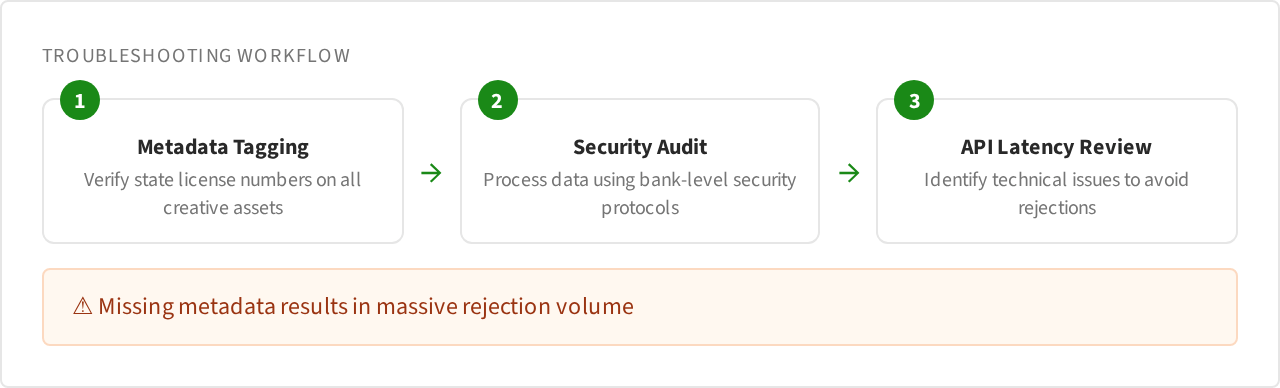
When data analysts perform security audits, they must ensure data processing aligns with bank-level security protocols and end-to-end encryption to protect data ownership with no third parties.
In the high-stakes gaming environment where sports betting advertising reaches a million dollar scale, identifying latency issues within the API is paramount.
Precise metadata serves as the primary identifier for automated scanners, meaning any deviation from platform-specific technical specifications results in a black-box rejection that disrupts seasonal NFL growth strategies.
Geo-fencing Technical Audit: Ensuring Verification Stability
To maintain high click-through rates and combat bot traffic, sophisticated fraud detection and advanced fraud detection tools are essential for monitoring fraudulent traffic patterns from click farms.
Using ad serving software with auto-scaling technology allows sports betting advertising to thrive across a 30+ ad format variety, including rich media and dynamic creatives.
Leading gaming brands like BetMGM and DraftKings use these trends to manage million dollar budgets while ensuring that set dynamic elements prevent geographic spillover in border-town targeting.
Modern betting advertising requires reporting and analytics within a creative management system to provide the visibility needed to adjust to seasonal advertising volume.
By prioritizing IP and GPS verification stability, brands can protect customers and manage ads effectively without falling victim to the automated triggers that frequently plague large-scale campaigns.
The Sniper Strategy for MLB and UFL Local Inventory
While DraftKings and BetMGM dominate national TV during the NFL season, mid-market operators can gain share through Private Marketplaces.
These PMPs give access to premium advertising volume without million-dollar costs for national sports betting ads during the playoffs.
Smaller operators often struggle with betting advertising costs. Regional targeting can acquire customers more efficiently than generic social reach.
Brands must monitor advertising volume trends to keep ads relevant.
By avoiding the massive national spend of fantasy-first companies, smaller brands can scale in niche areas where leaders often overlook inventory.
Local campaigns for NCAA baseball, softball, or lacrosse give an edge to brands that focus on sports betting.
During the Tallahassee or Los Angeles regionals, operators can use contextual targeting to reach Jaguars fans or audiences watching Hoosiers vs. Hurricanes.
Operators must set advanced filters to manage country-specific restrictions. Using hourly bidding helps brands optimize bidding strategies around live events.
Unlike DraftKings or BetMGM, smaller brands should use regional ads with specific targeting.
This ensures betting advertising stays profitable during NCAA finals.
These events attract over a million viewers and let agile brands capture market share.
- Secure inventory through local PMPs to bypass the high advertising volume of national conglomerates.
- Utilize advanced targeting capabilities to reach Jacksonville Jaguars fans through regional sports networks.
- Apply optimal hourly bidding strategies to capture market share during high-impact NCAA baseball and NCAA softball games.
Mid-market sportsbooks can outmaneuver national players by leveraging Private Marketplaces and hyper-regional, contextual targeting—capturing high-value, event-driven audiences more cost-effectively than broad national buys. Coupled with strict geo and compliance filters and hourly bidding around live events, this ‘sniper’ approach keeps advertising relevant and profitable without matching the massive national spend.
Independent Sports Betting Marketing Consultant
Turning One Off Super Bowl Bettors Into Loyalists
The fight for player lifetime value starts after the championship. Operators need a techready approach during the spring lull.
Marketers reach new heightstogether social engagement by turning fragmented attention into measurable growth.
This techready liftoff site strategy moves players toward the LPGA Tour and Serie A.
Operators use behavior to set up a webinarcracking code primetime sequence. This method focuses on targeting and custom offers instead of acquisition.
Success means [turning fragmented attention](https://altenar.com/blog/winning-with-data-your-sportsbook-performance-playbook/ ) into loyalty during the new heightstogether social calendar.
To keep high deposit rates and ARPU, creative work must focus on personal offers like NCAA brackets. A withdrawal tracker helps users manage bonus money.
A webinarcracking code primetime focus keeps injury promos relevant. During migrations, moving players to March Madness and the World Cup creates measurable growth.
This techready liftoff site uses new heightstogether social triggers to stop app deletions.
By turning fragmented attention to the Premier League, PGA Tour, and boxing matches, the platform monitors the Italian Serie A.
- Shift creative hierarchy from immediate sign-up incentives to season-long loyalty programs
- Implement multi-week bonus distribution to encourage habit formation beyond single events
- Utilize behavioral data to cross-sell bettors into niche markets like soccer or golf
- Focus on withdrawal management to increase the velocity of reinvested winnings
Surviving Impending PGA Tour and Betting Ad Bans
As markets mature, operators are moving away from celebrities like LeBron James to drive volume.
Due to new rules, betting advertising is shifting from endorsements to data-driven tools.
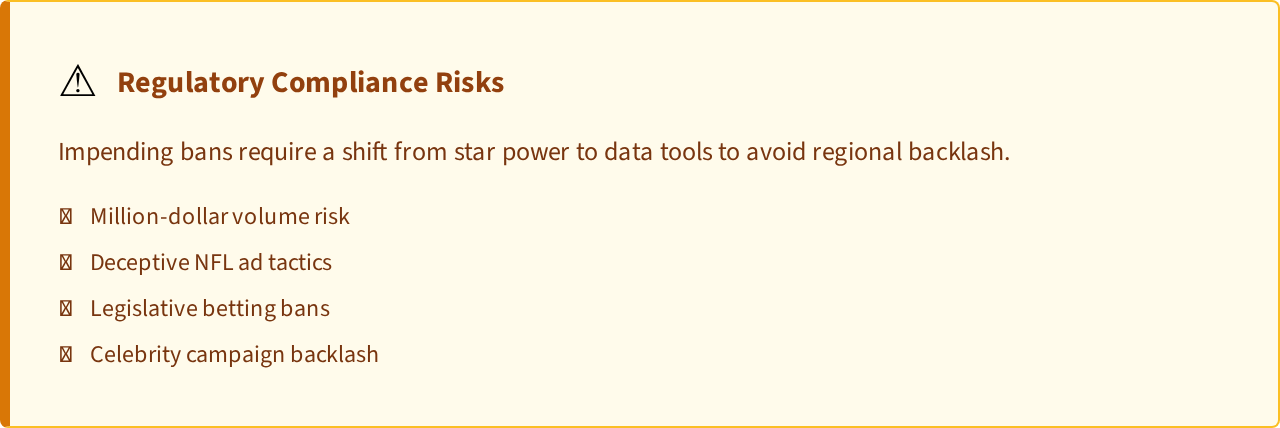
This change helps brands manage restrictions before fewer sports betting ads become law. By cutting flashy campaigns, sports betting advertising can avoid the backlash seen in other regions.
Intelligence tools help brands find deceptive tactics that might trigger rules during the NFL season.
AI and new algorithms are replacing old metrics as rules get stricter. Machine learning helps companies keep traffic without using star power.
This NFL season, DraftKings and BetMGM found that prediction market ads engage better than branding. These trends in sports betting show that advertising volume is growing toward a million dollars.
Companies must use clear content on social media.
To stay competitive against other categories, brands must use more creators and refine betting advertising trends.
BetMGM and DraftKings now use real-time data instead of flashy ads to avoid regulatory heat.
This shift shows customers million-dollar chances without the noise of sports betting advertising.
Using machine learning keeps advertising volume compliant while reaching the right audience during peak season.
- Prioritize real-time odds and algorithmic transparency over celebrity-led brand awareness campaigns.
- Adopt machine learning models to optimize creative delivery for high-intent gambling traffic.
- Monitor legislative trends around sports betting to proactively navigate ad restrictions before they become law.
- Diversify social media content to include prediction markets and educational financial stakes utility.
Conclusion
DraftKings and BetMGM focus on NFL trends and ROI instead of just advertising volume. Brands use sports betting ad servers to launch campaigns reaching millions.
Balancing costs against volume and performance helps these leaders win. They achieve million-dollar efficiency and better ROI.
Sales and marketing must use unified budgets and real-time updates to boost performance. Tools for data transfer and cross-channel work keep stakeholders confident during the season.
Advanced features let operators manage millions in spend. They use conversion data to meet strict performance goals.
Frequently Asked Questions
Why do January playoff games often yield a higher return on investment than the Super Bowl?
While the Super Bowl attracts the highest single-day viewership in the sports world, the January playoffs—including the NFL divisional round and conference championships—offer a window of high betting intent with significantly lower programmatic advertising costs. Operators often find that the cost per first-time deposit (cpFTD) is more favorable during these elimination games because the total advertising volume has not yet reached the peak saturation seen during championship weekend. By reallocating media budgets to these high-engagement periods, brands can capture active customers who demonstrate peak betting interest and maintain a higher lifetime value throughout the entire postseason.
How can sportsbook operators ensure compliance across different state jurisdictions?
Navigating the complex regulatory landscape requires a robust compliance framework that prioritizes the most stringent state requirements as a baseline for all national campaigns. This involves implementing standardized responsible gaming (RG) footers, such as the 1-800-GAMBLER mandate, and ensuring that all creative materials are vetted for age-gating accuracy and clear terms and conditions. Utilizing an advanced ad tech stack with precise geofencing capabilities allows operators to trigger state-specific disclosures automatically based on the user’s location, reducing the risk of automated ad rejections and protecting the brand from costly regulatory fines in highly scrutinized markets.
What technical solutions help prevent latency issues when using real-time odds in programmatic ads?
Integrating real-time betting odds into dynamic display banners requires high-performance ad servers and API-driven data feeds that minimize the delay between the sportsbook’s backend and the end-user’s screen. To maintain stability and technical excellence, operations teams should utilize edge computing and content delivery networks (CDNs) to reduce latency, ensuring that the odds displayed reflect current market conditions before a user clicks. Furthermore, implementing robust geo-fencing and demographic filters ensures that these data-heavy creative elements are only served to users in legal jurisdictions, preventing technical errors and compliance breaches while optimizing the race for the interface.
What impact do impending gambling advertising bans have on current media buying strategies?
As the market matures and faces potential restrictions modeled after European standards, leading operators are pivoting away from expensive celebrity spokespeople toward utility-focused content and prediction markets. This shift reduces the reliance on flashy branding that often attracts regulatory heat and instead focuses on providing data-driven insights directly to the consumer. By leveraging machine learning models and predictive modeling software, brands can maintain high engagement and conversion performance indices even as the available advertising volume for traditional linear spots decreases due to new legislative hurdles and increased public scrutiny.
How can smaller operators effectively compete with industry giants for premium ad inventory?
Mid-market brands can achieve a significant competitive advantage by utilizing a sniper strategy that targets niche, local inventory via Private Marketplaces (PMPs) rather than competing on national linear TV. By focusing on high-intent windows during regional events like the NCAA Tallahassee regional or local professional games, smaller brands can acquire customers at a much lower CPA than the million-dollar commitments required for national playoff spots. This hyper-local approach, combined with contextual targeting and precise bid adjustments, allows agile operators to capture market share in specific geographical areas where established giants may overlook specialized targeting parameters or regional ads.