Publisher Search Traffic Is Falling: Where Readers Went and How to Win Them Back

Publisher search traffic is shrinking fast. Search engines now drive just 12% of North American publisher pageviews, down from 21% a year ago, according to Chartbeat. Google Search referrals across its network fell 40.2% between July 2025 and July 2026.
Yet total publisher traffic held steady at around 31 billion pageviews a month. Readers didn’t disappear. They found other ways in. This article breaks down how far search traffic has fallen, why, where readers went instead, and six moves publishers can make now.
How far has publisher search traffic fallen?
Google Search referrals to publishers fell 40.2% in a single year, after a 21.9% drop the year before. That figure comes from Chartbeat’s 2026 Publisher Playbook, which compares July 2025 with July 2026. Google Discover fell too, by 34.3%.
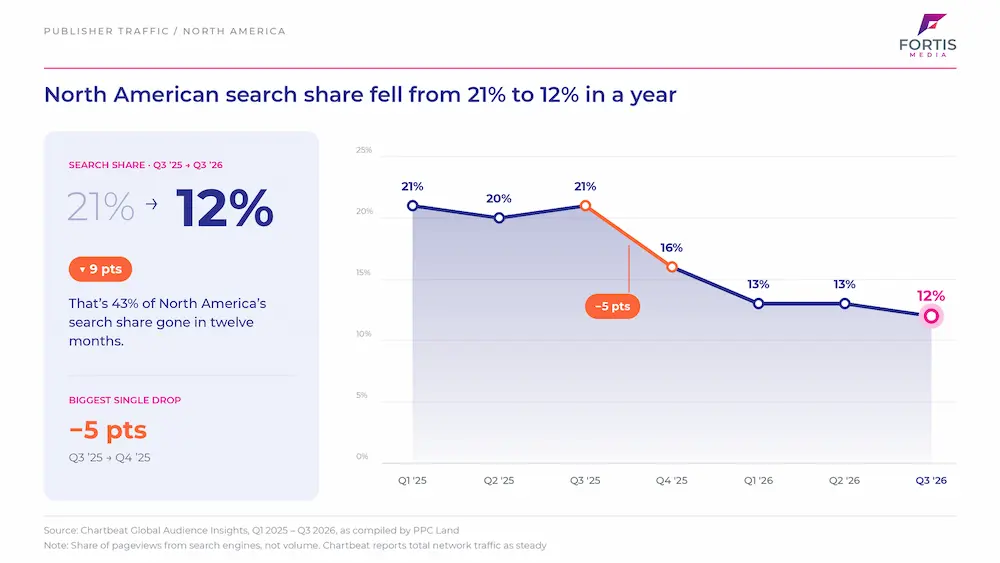
The quarterly data tells the same story. In North America, search’s share of publisher pageviews went from 21% in Q3 2025 to 16% in Q4 2025, then 13% in Q1 and Q2 2026, and 12% in Q3 2026. The biggest drop, five points, came in a single quarter at the end of 2025.
| Measure | Period | Change |
| Google Search referrals | Jul 2025 → Jul 2026 | −40.2% |
| Google Discover referrals | Jul 2025 → Jul 2026 | −34.3% |
| Search share of North American pageviews | Q3 2025 → Q3 2026 | 21% → 12% |
| Search share of network pageviews | Jul 2024 → Jul 2026 | about 9% → about 5% |
| Total network pageviews per month | 2025 → Jan–Jul 2026 | about 32B → 31.1B |
The last row matters most. Search shrank, but total traffic barely moved.
Search traffic by region
The decline isn’t just a North American problem. Search’s share of publisher pageviews fell in nine of the ten regions Chartbeat tracks.
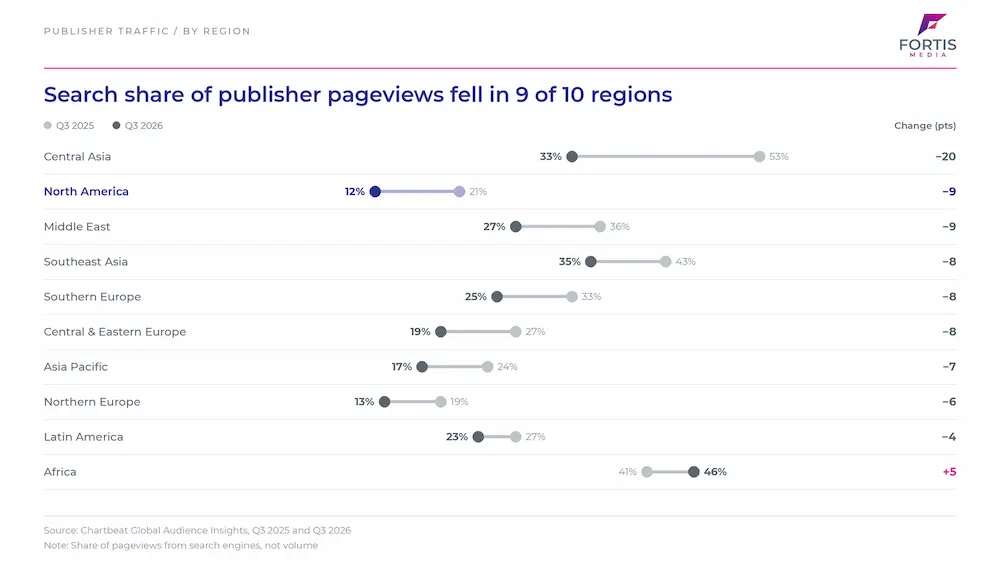
Central Asia lost the most, 20 points. Africa was the only region where search grew, and it now relies on search more than any other region.
Why publisher search traffic is declining
AI-generated answers are the most likely cause, though not the only one. Chartbeat has linked the decline to “AI’s growing impact on search” since 2025. Its latest quarterly report gives no cause at all.
AI Overviews answer the question on the results page. A Pew Research Center study of 900 US adults found people clicked a regular result on 8% of Google visits with an AI summary, against 15% without one. A separate randomized experiment found AI Overviews cut outbound organic clicks by 39.8%. Google disputes Pew’s method and says total clicks are relatively stable, but it has published no figures.
Generic content is hit hardest. Weather, definitions, TV schedules and quick factual answers can be settled by a summary in two sentences. The Reuters Institute found lifestyle and utility publishers lost the most.
Not every drop is AI. Google Discover’s 34.3% fall reflects a separate product change. Facebook and X referrals collapsed years earlier, for different reasons. The Reuters Institute says it is not yet clear how much of the decline comes from AI Overviews alone.
Where readers went instead
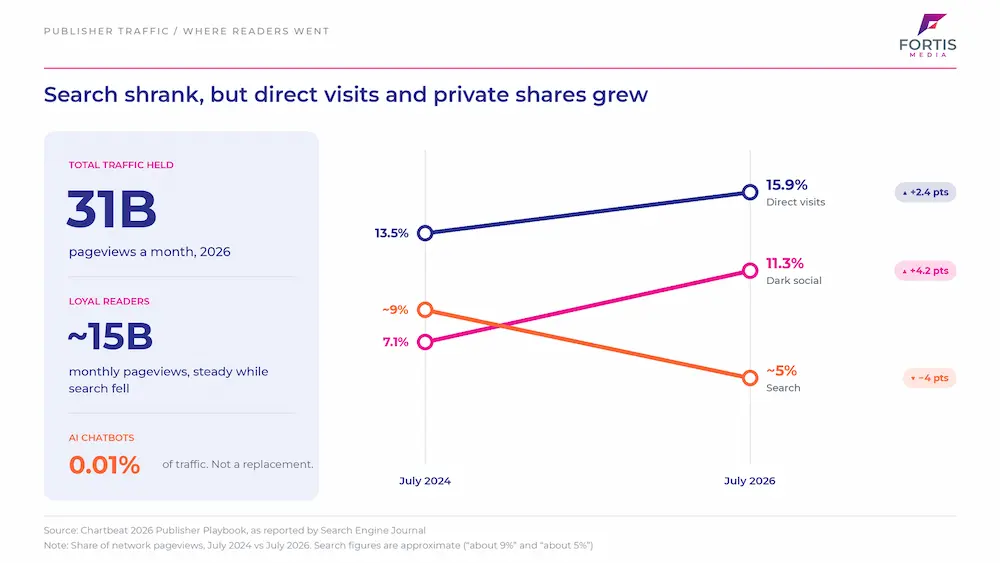
Loyal readers, direct visits and private sharing filled most of the gap. AI chatbots did not.
| Channel | What changed | Period |
| Loyal readers (visit on 8+ of 16 days) | Held steady at about 15B pageviews a month | 2025–2026 |
| Direct visits | 13.5% → 15.9% of pageviews | Jul 2024 → Jul 2026 |
| Dark social (links shared in private messages) | 7.1% → 11.3% of pageviews | Jul 2024 → Jul 2026 |
| Loyalty share, North America | 40% → 47% of pageviews | Q2 2025 → Q3 2026 |
| AI chatbots (ChatGPT, Claude, Perplexity, Copilot, Gemini) | 0.01% of publisher traffic | 2026 |
One caution: when search shrinks, loyal readers naturally make up a bigger slice of what’s left, even if their numbers don’t change. That’s why the steady 15B figure matters more than the rising share.
Six moves to protect your publisher traffic
Treat search as one channel among several, and invest in the ones you control.
- Build loyalty. Newsletters, apps and sign-ins turn one-off visitors into habits, and email marketing is the easiest place to start. Loyal readers kept about 15B monthly pageviews steady while search fell.
- Win direct visits. Make your homepage and brand a place people go on purpose. Digital PR builds the brand recognition that drives it. Direct traffic rose from 13.5% to 15.9% of pageviews in two years.
- Make stories easy to share privately. Add sharing for WhatsApp, Messenger and email. Dark social grew from 7.1% to 11.3% of pageviews.
- Publish what AI can’t summarise. Original reporting, analysis and data give readers a reason to click. A content marketing strategy built around expertise beats generic answers, which will keep losing to AI summaries.
- Become a Preferred Source on Google. Ask loyal readers to add you. Google says use of the feature grew sevenfold in 2026, though it shared no click data.
- Don’t count on chatbots for traffic yet. At 0.01% of publisher traffic, AI assistants are not a replacement for search. Being cited in their answers still builds visibility, which is where LLM SEO comes in.
How to measure your own search traffic correctly
Track the number of search pageviews, not just search’s share of your traffic. A falling share can mean search sent fewer readers, or that other channels grew. Only the count tells you which.
- Compare quarter by quarter. Log search-referred pageviews each quarter, next to your total.
- Benchmark your share. Set your search share against Chartbeat’s regional figures, such as 12% in North America.
- Split Google’s surfaces. Separate Search, Discover and News in your analytics, since they are falling for different reasons. A proper data and analytics setup makes this a standing report rather than a one-off.
- Watch impressions too. In Google Search Console, rising impressions with falling clicks usually point to AI Overviews or other results-page features. An SEO audit can show which pages are affected.
How Fortis Media can help
The same shift hits any brand that relies on organic search, not just publishers. Fortis Media is a search marketing agency for regulated industries such as iGaming, crypto and fintech, and also works with SaaS, ecommerce and enterprise brands. Our clients see an average 30% increase in organic traffic in their first year.
We help brands adapt to a smaller search channel in five ways:
- Visibility in AI answers: LLM SEO for ChatGPT, Perplexity, Gemini and Copilot.
- Content AI can’t replace: expert-led content marketing.
- Channels you own: email marketing that builds a loyal audience.
- Brand demand: digital PR that drives direct visits.
- Measurement: data and analytics that track real traffic, not just shares.
Want to know how much of your traffic is at risk? Get a proposal and we’ll start with an audit.
Frequently asked questions (FAQs)
Why is publisher search traffic declining?

AI Overviews and other AI answers settle many queries on the results page, so fewer people click through. Changes to Google Discover and long-term shifts in social referrals add to the drop.
How much search traffic have publishers lost?
Google Search referrals across Chartbeat’s network fell 40.2% between July 2025 and July 2026. In North America, search’s share of publisher pageviews fell from 21% to 12% in a year.
Is overall publisher traffic falling too?
Not in Chartbeat’s network. Publishers averaged 31.1B pageviews a month in early 2026, against about 32B in 2025, as loyal readers and direct visits held up.
Do AI chatbots send traffic to publishers?
Very little. ChatGPT, Claude, Perplexity, Copilot and Gemini together sent 0.01% of publisher traffic in Chartbeat’s 2026 data.
Which region still gets the most traffic from search?
Africa. Search accounted for 46% of publisher pageviews in Africa in Q3 2026, the highest share of any region. It was also the only region where search’s share grew over the year, up from 41%.